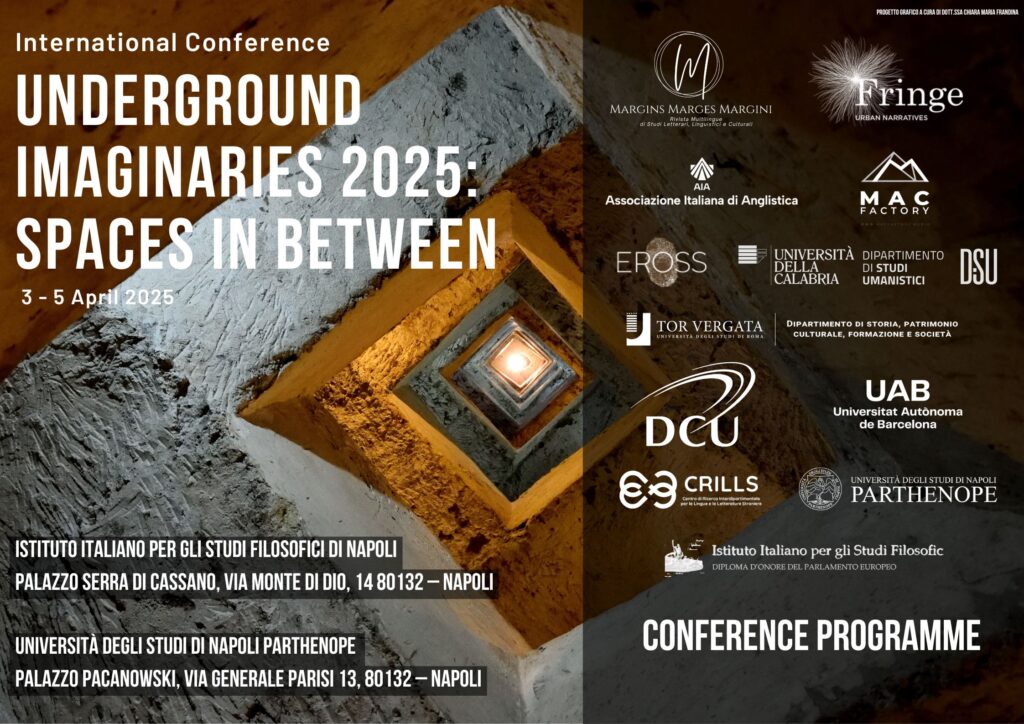
CFP From the European South Issue 19 | Special Issue: Dark Tourism in Colonial, Postcolonial and Decolonial Contexts: Topographies of Suffering, Narrative Constructions and the Consumption of Place(s) | Fall 2026

Guest Editors: Eleonora Federici (University of Ferrara) and Marilena Parlati (University ofPadova) From the European South invites submissions for a special issue dedicated to exploring dark tourism in colonial, postcolonial and decolonial contexts, with a particular focus on the role literature, language, museum culture and storytelling in general may have in representing, but also cordoning off, global topographies of suffering, such as sites of catastrophes, genocide, environmental change and neocolonial exploitation. The editors of this issue aim to critically examine the complex relationships between dark tourism and colonial legacies, postcolonial realities and imagined communities, and also the possibilities entailed by decolonization processes. We specifically seek contributions that analyze how dark tourism sites are experienced, consumed and represented, especially in relation to the Global South.With reference to publications about dark tourism (Lennon and Foley, Dark Tourism, the Attraction of Death and Disaster 2000; Sion, Death Tourism Disaster as Recreational Landscape 2014), we wish to analyse how sites associated with death and disaster (assassination, slavery, genocide, war, tragic events) become tourist attractions. Linguistic, visual and multimodal elements help to create a representation of these sites as places of memory, education, but also, quite controversially, leisure.We are also interested in the ways in which the consumption of ‘shadow zones’ shapes these processes, both in the present and in a future-oriented perspective. We are aware that no singling out of ‘one’ memory is less than intensely debatable, since any past idea about national memory as cohesive and intrinsic has luckily often – although not everywhere – been dismantled. Thus, we would also welcome papers that help usher in discussions on the risk that memory sites (dark, in particular) may serve to reinforce overpowering ‘invented traditions’ and monolingual master narratives (see Derrida, The Monolingualism of the Other 1998). We suggest a few potential areas of focus which include, but are not limited to:● The influence of literature on the experience, interpretation and discursiverepresentation of dark tourism sites● The impact of colonial and postcolonial literatures on dark tourism site representationand vice versa● The role of fiction and non-fiction in shaping visitor expectations and experiences● Written narratives, on-site storytelling, multi-format (including digital) narratives indark tourism● Digital consumption of dark tourism places: virtual tours and social mediarepresentations● Linguistic and multimodal strategies in tourism texts (on site texts; leaflets,brochures, websites, blogs, social media)● The role of art and tourism discourse in commemorating and interpreting sites oftrauma, also in relation to reconciliation processes● Resistance, resurgence and/or reconciliation in dark tourism sites: mappingtopographies of suffering in colonial and postcolonial contexts● Tourism and postcolonial memory: the commodification of traumatic pasts, and therole of dark tourism in (postcolonial) nation-building and place branding● Indigenous tourism and dark sites: negotiating consumption, sacredness, andresistance● Shadow zones: Conflicting narratives and dissonant memories in colonial,postcolonial, decolonial dark tourism sites● ‘Authenticity’ and staged experiences in colonial/postcolonial/neocolonial darktourism sites● Intergenerational transmission of guilt, shame, and responsibility through darktourism● Dissonant memories: managing, re-presenting, revisiting conflicting historicalnarratives● Indigenous cosmologies and their integration in (or exclusion from) dark tourismnarratives We welcome contributions from various disciplines, including but not limited to: anthropology, cultural studies, gender studies, geography, history, literary studies, media studies, museum and heritage studies, philosophy, political science, postcolonial studies, religious studies, sociolinguistics, sociology, translation studies, tourism studies, urban planning. Please submit your abstract (500 words) and a brief bionote by Wednesday 1 October 2025 to both Eleonora Federici (eleonora.federici@unife.it) and Marilena Parlati (marilena.parlati@unipd.it).Notification of acceptance will be communicated by Monday 1 December 2025, with completed papers due 1 March 2026. FES 19 will be published in Fall 2026. https://www.fesjournal.eu/call/issue-19-special-issue-dark-tourism-in-colonial-postcolonial-and-decolonial-contexts-topographies-of-suffering-narrative-constructions-and-the-consumption-of-places-fall-2026/
CFP From the European South Issue 19 | Special Issue: Dark Tourism in Colonial, Postcolonial and Decolonial Contexts: Topographies of Suffering, Narrative Constructions and the Consumption of Place(s) | Fall 2026 Read More »

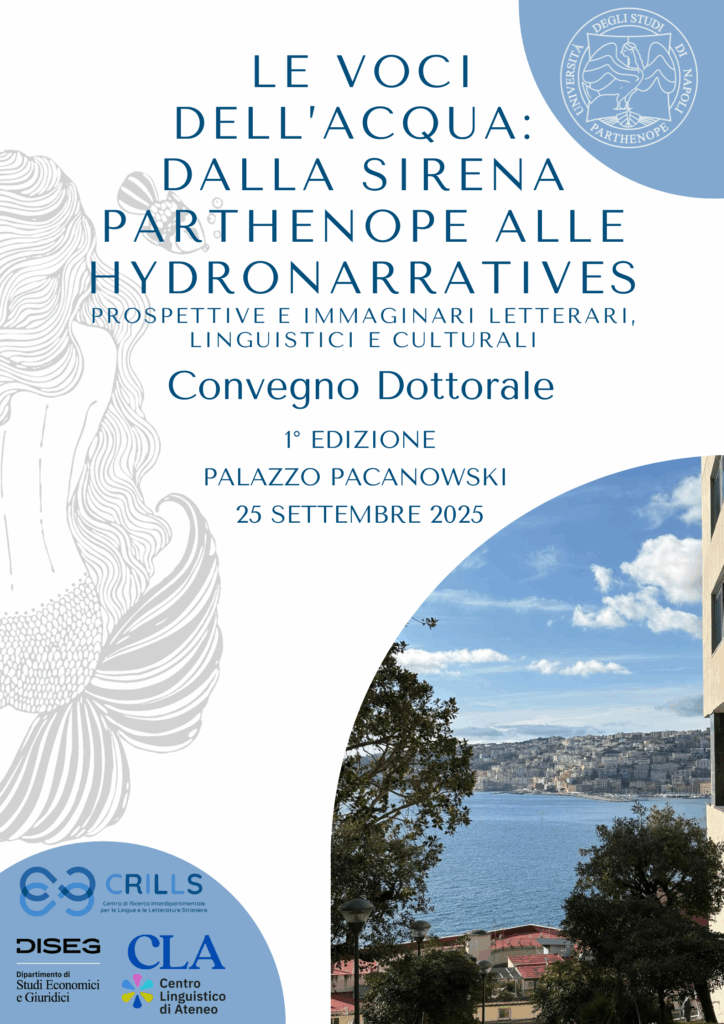
CALL FOR PAPERS: “Voices Across Water: From the Sirena Parthenope to Hydronarratives”

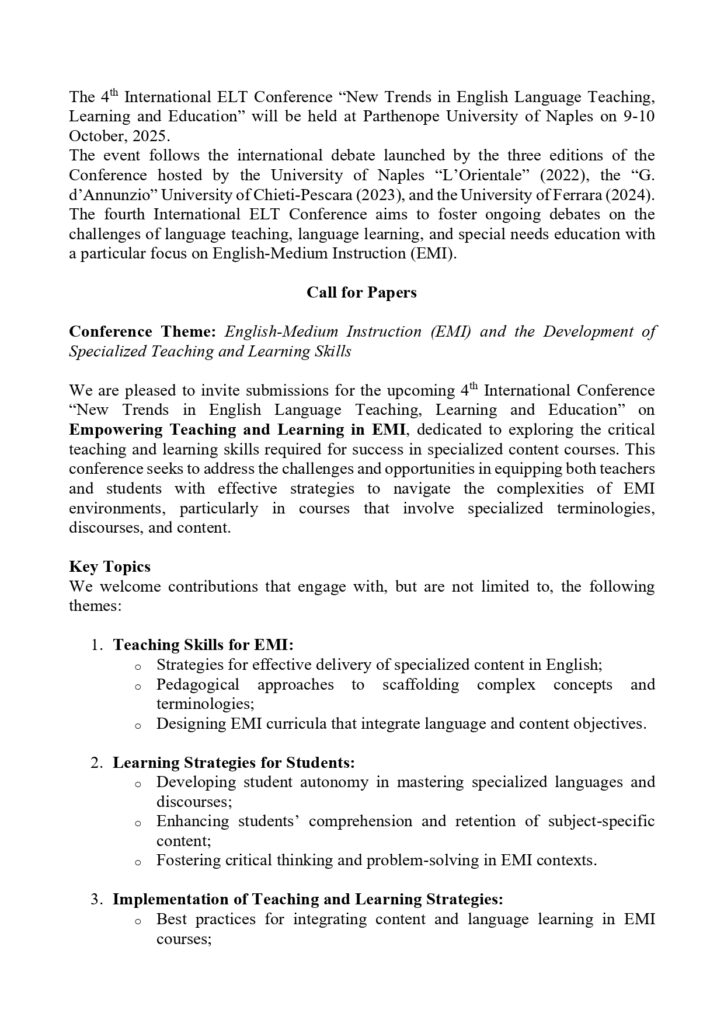
1st Graduate Conference of the PhD Programme in Linguistic, Terminological and Intercultural StudiesSeptember 25th, 2025Parthenope University of Naples Parthenope University of Naples proudly invites PhD students to participate in the 1st Graduate Conference of the PhD Programme in Linguistic, Terminological and Intercultural Studies, “Voices Across Water: From the Sirena Parthenope to Hydronarratives”, on September 25th, 2025. The conference seeks to explore the profound impact of water as a central theme across diverse literary, linguistic and cultural domains. Given the inherent maritime connection uniting our SEA-EU alliance, we encourage submissions that critically examine the role of water in shaping narratives in Italian, English, French and Spanish. We welcome interdisciplinary approaches and innovative perspectives that illuminate the evolving landscapes of hydronarratives.Please check out the conference website [https://www.graduateconferenceparthenope.it] for the complete Call for Papers, submission guidelines and important deadlines. We look forward to welcoming you to this unique event, celebrating our maritime heritage!

CALL FOR PAPERS: “Voices Across Water: From the Sirena Parthenope to Hydronarratives” Read More »

Numero speciale della rivista LEA – Lingue e Letterature d’Oriente e d’Occidente

Siamo lieti di comunicarvi che è stato appena pubblicato il numero speciale della rivista LEA – Lingue e Letterature d’Oriente e d’Occidente ( https://oajournals.fupress.net/index.php/bsfm-lea), diretta da Ilaria Natali, dedicato a Literary and Linguistic Perspectives on Healthcare and Disease: Themes and Trends from the Eighteenth Century to the Present. Il progetto si pone in continuità con Textus 3/2024 e raccoglie saggi che, per mere ragioni di spazio, non avevano potuto trovare accoglienza in quella sede. Il numero speciale è diretto da Ilaria Natali, Girolamo Tessuto, Clark Lawlor e Annalisa Federici. Il numero di LEA è consultabile al seguente link: https://oajournals.fupress.net/index.php/bsfm-lea/issue/view/682 LEA rimane aperta a proposte provenienti dall’intera comunità di studiose e studiosi del macrosettore, con l’auspicio di continuare a offrire uno spazio di confronto e crescita condivisa.

Numero speciale della rivista LEA – Lingue e Letterature d’Oriente e d’Occidente Read More »

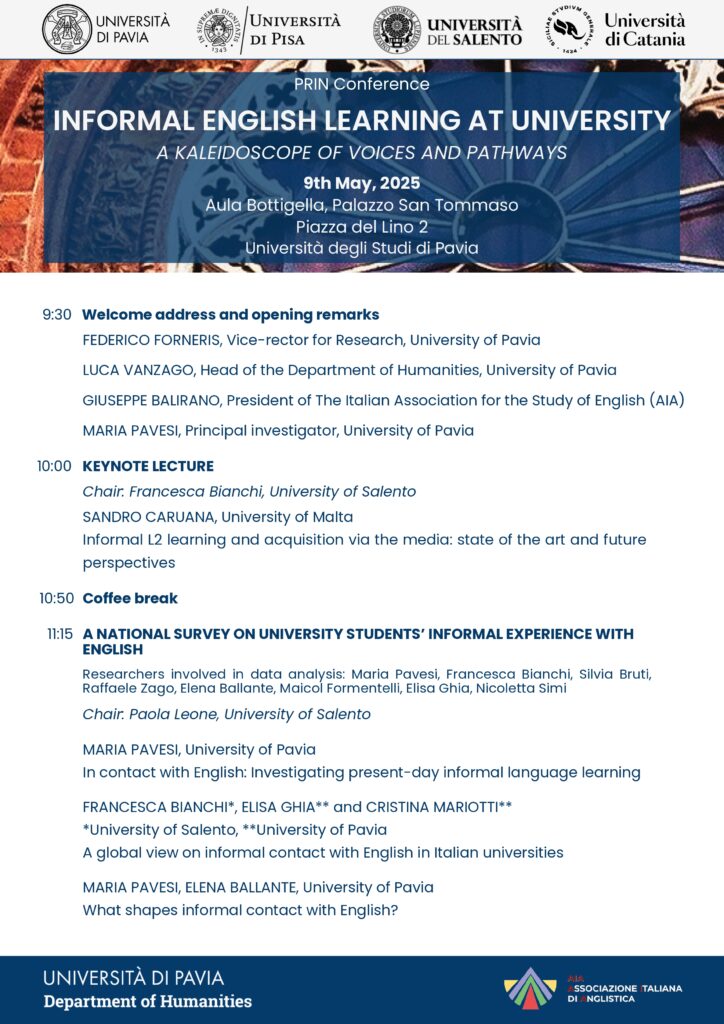
Call for Papers – XXVIII International Conference of O&L

Potenza 24-26 September 2025The XXVIII International Conference of O&L will take place at the University of Basilicata. The conference will be held in the Aula Magna of the Francioso Campus and in the Hall of the National Archaeological Museum of Basilicata Dinu Adamesteanu, Potenza. Additionally, on September 27, a visit will be organized to the Sassi of Matera, which were listed as a UNESCO World Heritage Site in 1993. The detailed program of the visit and the registration procedures will be provided to interested participants. The Conference will focus on the following topics:The names of ‘villains’ (antagonists and negative characters).The relevance of the names of literary ‘villains’ and/or ‘antagonists’ is already evident when we consider a peculiar linguistic phenomenon: many of them have become so famous that they have turned into antonomasies, or even lexicalized into deonyms. Among those attested in the lexical heritage of Italian and its dialects, one could think, for example, of ‘Ganelon / Gano di Maganza,’ which has become synonymous with ‘traitor’ (alongside ‘giuda’), also appearing with the epithet ‘(treacherous) Maganzese’. Beyond this, other purely literary cases can be listed within the same domain, which have already been studied by critics, such as the names of the devils Malebranche in Dante’s Divine Comedy and those of the Shakespearean theatrical characters Macbeth, Shylock, Iago, or the Molière character Tartuffe, may be counted in the same sphere. The name in autobiographical writingsIn autobiography, understood as a literary form, there is an onomastic identity between the author, narrator, and protagonist, which refers to the same entity. The enunciation of the name of the authornarrator-protagonist, therefore, constitutes a key element for reading, capable of guiding the reader’s interpretative cooperation and the process of meaning-making within the work. However, the enunciation of the nominal identity of the one who takes the floor rarely appears within the text, while it is often displayed in the paratext. The narrator who designates himself with a first-person pronoun, therefore, does not have a name, and yet, as Roland Barthes emphasizes, that pronoun, in the narrative, becomes an anthroponym, unless the narrator leaves some onomastic trace within the text. Equally significant are the procedures that affect the names of other characters involved in autobiographical writings, which may, for example, be subject to various kinds of omissions, because they are hidden by anonymity or disguised through substitute names. The same ambivalent attitude may also involve the names of the places where the action is set. Therefore, this section could include all investigations aimed at detecting and revealing the often unsuspected autobiographical resonances hidden behind the onomastics of a text. Anthropological foundations of the name: taboo, apotropaic or magical namesIt is well known that in Le Conte du Graal by Chrétien de Troyes, the reader (and the character who bears the name) comes to know the protagonist’s name only at a very advanced stage of the poem: the revelation assumes an initiatory value, reaching the peak of a difficult process of self-knowledge. The Kretienian ‘taboo of the name’ is certainly not the only example where a literary name seems to regain the magical and apotropaic significance, with complex anthropological meanings, traces of which were widespread and profound in primitive onomastics, and which also characterized the prohibition of pronouncing the divine Tetragrammaton in Jewish tradition. However, in this section, which could also be titled, playing on Freud’s words, Nomen and tabù, one could certainly include other well-known cases seen from different perspectives, such as that of the Erinyes, often referred to by the apotropaic name Eumenides (as in Aeschylus’s tragedy or in the title of the famous novel by Jonathan Littell, Les Bienveillantes, which mirrors the same mythological model of the persecution of Orestes by the Erinyes); or famous literary examples, such as the case of the figure of the Innominato in Manzoni’s novel, struck by a sort of interdiction that evokes the previously mentioned prohibition of pronouncing the divine name. Cases of autonymy: when a character assigns themselves a name, a nickname, or a pseudonymAmong the cases in which a literary character is compelled, for various reasons, to re-name themselves, the first examples that come to mind are certainly classic ones, such as Alonso Quijano / Don Quixote, Jekyll / Hyde, or, in twentieth-century Italian literature, Mattia Pascal / Adriano Meis. Beyond this specific corpus, however, other forms of autonymy can be found, even if seemingly less striking, such as those of the Decameron characters, who assume different onomastic forms from their official names during various disguises: from Tebaldo degli Elisei / Filippo di San Lodeccio to Lodovico / Anichino, or, with a change of gender, Madonna Zinevra / Sicuran da Finale. To mention a twentieth-century example, one can think of the programmatic battle names that partisans give themselves in post-World War II stories. But other types can also be suggested. One involves the author themselves when they, to some extent, take on a substitute name, either to hide or, conversely, to showcase a particular authorial stance. One thinks of the kaleidoscopic array of heteronyms by Pessoa, but also more unsuspected cases, such as that of Luzi, who in some collections hints at himself under real names and profiles like Simone Martini. Also, in the realm of authorial posture, one can cite the self-deprecating, diminutive autonyms, with a programmatically self-ironic and reductive intent, such as ‘guidogozzano’. Submerged Lucanità: Onomastic Explorations from Rocco Scotellaro to Gaetano CappelliThe occasion of the conference in Potenza offers numerous onomastic insights not only for the general ‘anniversary section’ but also for the more specific literary production of Lucanian authors. This year, in particular, marks the fiftieth anniversary of the death of Carlo Levi, whose Christ Stopped at Eboli (it is needless to emphasize its significance in the history of Basilicata) reveals a complex relationship between reality and invention, particularly within the onomastic fiction. Additionally, the onomastic choices of Lucanian poets and writers, which draw from the reality of the so-called peasant civilization, are still underexplored but certainly worth investigating. These include Rocco

Call for Papers – XXVIII International Conference of O&L Read More »

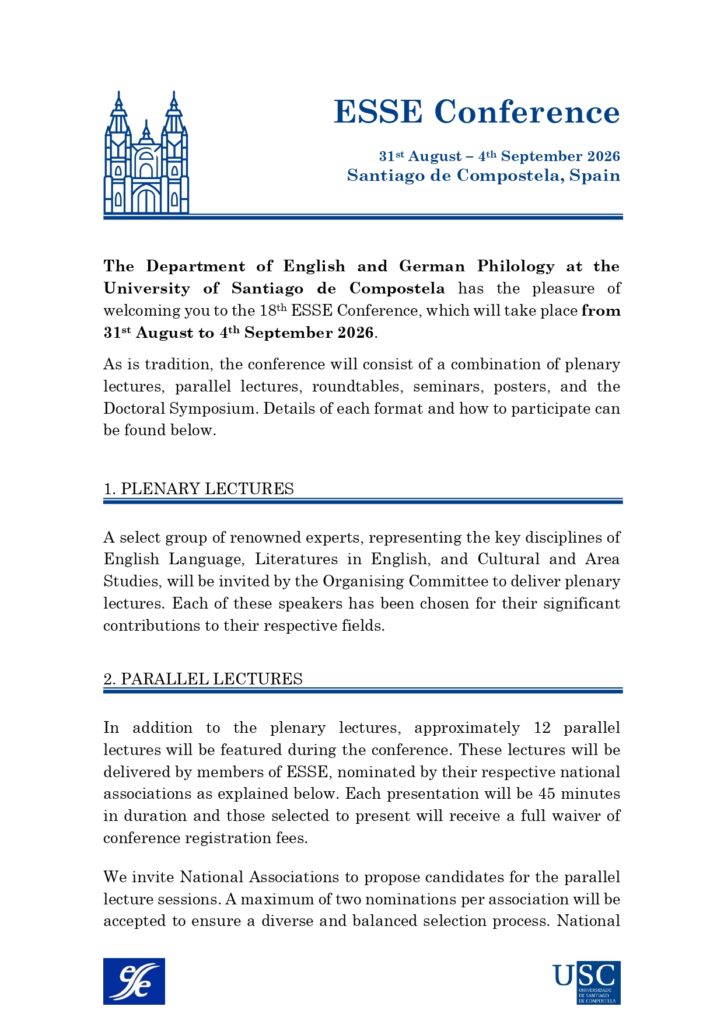
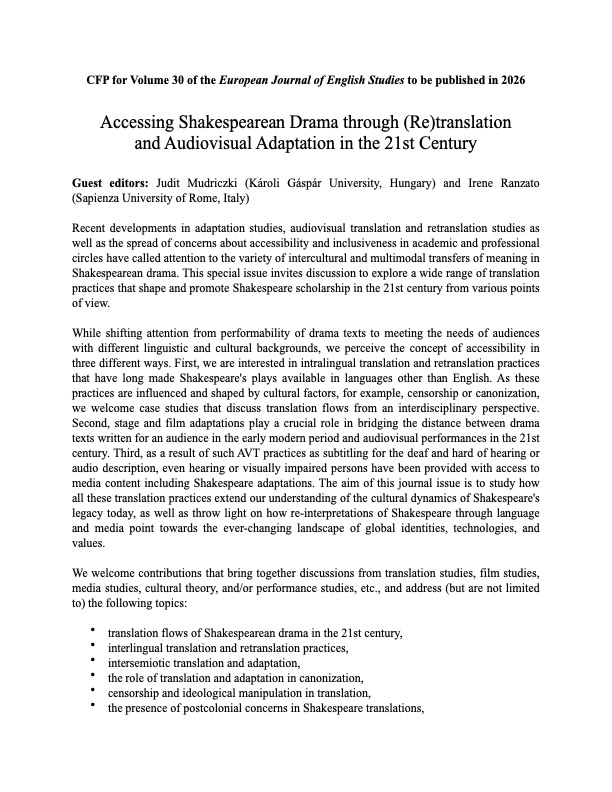
CALL FOR PAPERS for Volume 30 of the European Journal of English Studies to be published in 2026

Accessing Shakespearean Drama through (Re)translation and Audiovisual Adaptation in the 21st Century Guest editors: Judit Mudriczki (Károli Gáspár University, Hungary) and Irene Ranzato (Sapienza University of Rome, Italy)Recent developments in adaptation studies, audiovisual translation and retranslation studies as well as the spread of concerns about accessibility and inclusiveness in academic and professional circles have called attention to the variety of intercultural and multimodal transfers of meaning in Shakespearean drama. This special issue invites discussion to explore a wide range of translation practices that shape and promote Shakespeare scholarship in the 21st century from various points of view. While shifting attention from performability of drama texts to meeting the needs of audiences with different linguistic and cultural backgrounds, we perceive the concept of accessibility inthree different ways. First, we are interested in intralingual translation and retranslation practices that have long made Shakespeare’s plays available in languages other than English. As these practices are influenced and shaped by cultural factors, for example, censorship or canonization, we welcome case studies that discuss translation flows from an interdisciplinary perspective. Second, stage and film adaptations play a crucial role in bridging the distance between drama texts written for an audience in the early modern period and audiovisual performances in the 21st century. Third, as a result of such AVT practices as subtitling for the deaf and hard of hearing or audio description, even hearing or visually impaired persons have been provided with access to media content including Shakespeare adaptations. The aim of this journal issue is to study how all these translation practices extend our understanding of the cultural dynamics of Shakespeare’s legacy today, as well as throw light on how re-interpretations of Shakespeare through language and media point towards the ever-changing landscape of global identities, technologies, and values. We welcome contributions that bring together discussions from translation studies, film studies, media studies, cultural theory, and/or performance studies, etc., and address (but are not limited to) the following topics: • translation flows of Shakespearean drama in the 21st century,• interlingual translation and retranslation practices,• intersemiotic translation and adaptation,• the role of translation and adaptation in canonization,• censorship and ideological manipulation in translation,• the presence of postcolonial concerns in Shakespeare translations,• inclusiveness and media accessibility of Shakespeare adaptations,• audiovisual translation practices of screen adaptations,• audio description and subtitling of Shakespeare on screen,• surtitling Shakespeare performances. Detailed proposals (up to 1,000 words) for full essays (approx. 7,500 words), as well as a short biography (max.100 words) should be sent to both editors by 20 April 2025: Judit Mudriczki (mudriczki.judit@kre.hu) and Irene Ranzato (irene.ranzato@uniroma1.it) EJES operates in a two-stage review process.1. Contributors are invited to submit proposals for essays on the topic in question by 20 April 2025.2. Following review of the proposals by the editorial board panel, informed by external specialists as appropriate, the guest editors will invite the authors of short-listed proposals to submit full-length essays for review with a summer 2025 deadline.3. The full-length essays undergo a second round of review, and a final selection for publication is made. Selected essays are revised and then resubmitted to the guest editors in late 2025 for publication in 2026. EJES employs Chicago Style (T&F Chicago AD) and British English conventions for spelling. For more information about EJES, see: http://www.essenglish.org/ejes.html and https://[www.tandfonline.com/toc/neje20/current]www.tandfonline.com/toc/neje20/current

CALL FOR PAPERS for Volume 30 of the European Journal of English Studies to be published in 2026 Read More »

Torna in alto