News

AIA Summer School 2026: Re-Mix, Re-Appropriation, Re-Imagination. University of Salerno, 15-17 July

Registrations are open! Please check the programme and registration procedures here: AIA Summer School 2026 Programme   Practical information:  Hotels close to main station and centro storico Hotel 4 stelle Montestella – camera singola – € 114,00 Hotel 3 stelle BnB  

AIA Summer School 2026: Re-Mix, Re-Appropriation, Re-Imagination. University of Salerno, 15-17 July Read More »

AIA FOR SCHOOLS — SEMINARIO: ECOSTYLISTICS IN/ACROSS THE ANGLOSPHERE 19 maggio 2026, ore 14:00-16:00

Relatore: Prof. Esterino Adami – Dipartimento di Scienze Umanistiche, Università di Torino Docente promotrice: Prof.ssa Giuseppina Balossi 19 maggio 2026, ore 14:00-16:00 Aula Magna, Liceo Scientifico e Musicale “G. B. Grassi” – L.go Montenero 3 – 23900, Lecco Destinatari/e Il seminario è rivolto ai/alle docenti di lingua inglese, ma aperto anche a docenti di altre discipline, in un’ottica di raccordo multidisciplinare nell’ambito delle aree umanistiche. L’iniziativa è destinata non solo ai/alle docenti del Liceo Scientifico e Musicale “G.B. Grassi”, ma anche a docenti degli istituti secondari di secondo grado della provincia di Lecco. Descrizione del seminario Il seminario ha lo scopo di promuovere un dialogo interdisciplinare nell’ambito delle Humanities e mostra come campi di studio quali l’ecostilistica e l’ecolinguistica possano contribuire a una migliore comprensione del discorso ecologico contemporaneo nelle sue molteplici forme, sia letterarie sia non letterarie. Esso introduce inizialmente teorie linguistiche e metodi di analisi, per poi affrontare tematiche ambientali attraverso l’analisi di una selezione di generi e testi provenienti dalla più ampia Anglosfera. Seminar description Promoting an interdisciplinary dialogue within the Humanities, this seminar shows how fields such as ecostylistics and ecolinguistics can contribute to a deeper understanding of contemporary ecological discourse in its many fictional and non-fictional forms. It first introduces key linguistic theories and analytical methods, and then addresses environmental issues through the analysis of a selection of genres and texts from the broader Anglosphere.

AIA FOR SCHOOLS — SEMINARIO: ECOSTYLISTICS IN/ACROSS THE ANGLOSPHERE 19 maggio 2026, ore 14:00-16:00 Read More »

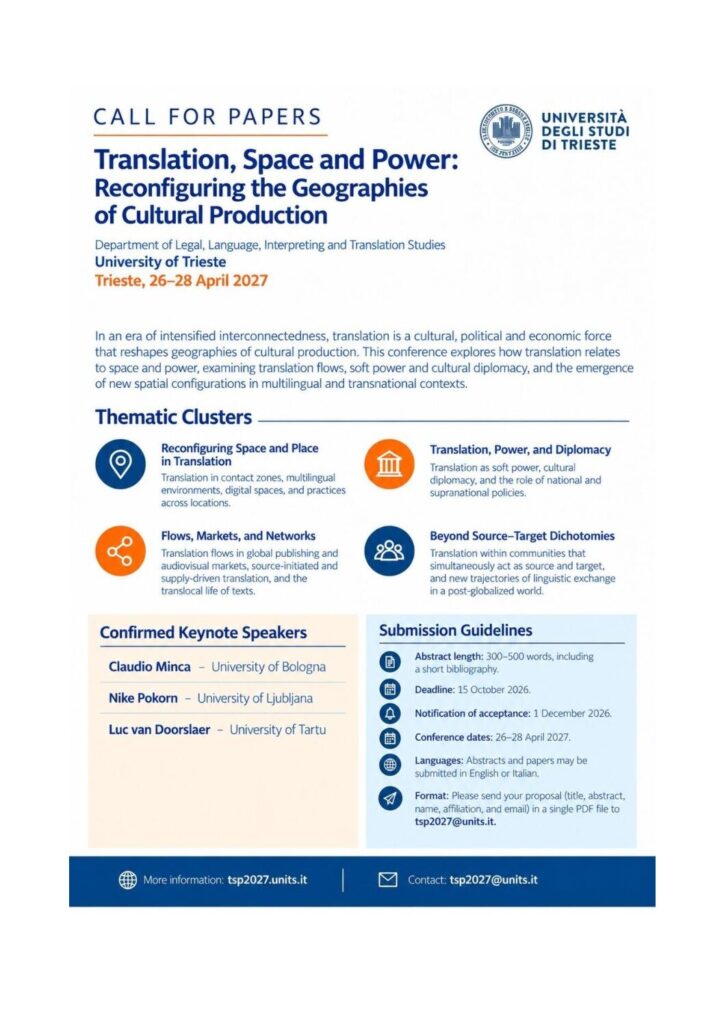
CALL FOR PAPERS 5th International ELT Conference: New Trends in English Teaching, Learning and Education

University of Brescia, Italy 2-3 October 2026 The 5th International ELT Conference “New Trends in English Teaching, Learning and Education” will be held at the University of Brescia on 2-3 October 2026. The event follows the international debate launched by the four editions of the Conference hosted by the “L’Orientale” University of Naples (2022), the “G. d’Annunzio” University of Chieti-Pescara (2023), the University of Ferrara (2024) and the “Parthenope” University of Naples (2025). The fifth International ELT Conference aims to foster ongoing debates on the challenges of language teaching, language learning, and special needs education with a particular focus on variants of English for Academic and Professional Purposes. Conference Theme: English(es) for Academic and Professional Purposes English as a Foreign Language (EFL) teaching and training is focused too often on general disciplinary skills rather than the specific professional needs required by the workplace. The conference intends to address emerging and developing variants of “English Linguistics for Academicians and Professionals” (ELAP) resulting from innovative approaches to teaching and learning, new needs and skills of the job market, and the increasingly complex implementation of interactive technology and Artificial Intelligence in all phases of course planning, delivering, and applying in the professions. Key speakers • Prof. Ofelia Palermo – Professor of Relational Leadership, MSc International Business Leader – Nottingham Trent University Ofelia Palermo | Nottingham Trent University • Prof. Helen Xanthaki – Professor at the Faculty of Laws, UCL London, Dean of the Postgraduate Laws Programmes of the University of London (Worldwide) Helen Xanthaki | About | University College London • Prof. David Tual – Professor of Language Education, Director of the Centre for Languages and Inter-Communication at the University of Cambridge David Tual | Department of Engineering Key topics We welcome contributions that engage with, but are not limited to, the following themes related to ELAP: • Changes in teaching methods, approaches, and strategies in view of novel and growing professions • New skills and learning needs of students within a professional perspective • Innovations in online, blended, and hybrid courses • Uses of AI in implementing ELAP • Interdisciplinary methodologies for innovative ELT (English Language Teaching) • Higher Education (HE) and the professions • Best practices in English language communication in professional contexts • Reskilling and upskilling in HE • ELAP in lifelong learning Submission Guidelines We invite submissions of abstracts relevant to the conference themes at the e-mail address elt2026@unibs.it. Word count: 300 words, excluding bibliography. Language: English. Format: Include title, author(s), affiliation(s), e-mail address(es), and 3-5 keywords. Key Dates Abstract submission deadline: 30 June 2026 Notification of acceptance: 15 July 2026 Registration deadline: 20 September 2026 Conference dates: 2-3 October 2026

CALL FOR PAPERS 5th International ELT Conference: New Trends in English Teaching, Learning and Education Read More »

New deadline (8 May) for International Conference “Pleasure and Pain in Women’s Writing” – IWWA (International Women’s Writing Association) and the L&GEND Research Group (with AIA sponsorship)

New deadline: 8 May9th-11th September 2026G. d’Annunzio University of Chieti-Pescara, ItalyConference Venue: Department of Modern Languages, Literatures and Cultures, PescaraThis in-person conference of the International Women’s Writing Association (IWWA), organized incollaboration with the L&GEND (Literature & Gender Identity) International Research Group, willbe held at G. d’Annunzio University in the Pescara Campus, offering an interdisciplinary and cross-period investigation of women’s writing in all its forms, mediums, and expressions.The conference explores sensations of pleasure and pain in women’s writing, examining how theseexperiences are shaped, interpreted and endowed with meaning in texts produced by women acrossdifferent cultures and historical periods. As theorized by Henri Bergson, pleasure and pain providecrucial insights into the past, present and future; they belong to complex sensory systems that resistautomatic responses to the world and contribute to the formation of consciousness. In this sense, theyfunction as vehicles of resistance, freedom, and awareness (Suzanne Guerlac, Thinking in Time,2006). By investigating representations of pleasure and pain, the conference aims to foster criticalreflection on how women narrate intense, gendered sensory experiences, how they foreground thesocial consequences of women’s emotional vulnerability, and how they articulate forms of strategicrestraint alongside assertions of individual freedom to experience pleasure or suffering with intensity.Speakers are invited to examine these dynamics in a variety of genres, forms of cultural productionand media, including written literature and the digital, poetry and prose, the popular and the canonical,creative and factual writing, life-writing and biographies, theories and histories, screen and script,films and television. We encourage the exploration of collaborative and individual works, ofimaginative practices and women’s realities, of representation of personal and public issues, across awide range of disciplines, time periods, cultures and texts.We welcome submissions for individual twenty-minute papers as well as for full panels andworkshops. Topics might include, but are not limited to:● Women’s writing on page, stage, and screen● The portrayal and evolution of pleasures and pains across different periods and genres● Cultural, historical, and social contexts for pleasure and pain● Trauma in women’s writing● Representations of physical and psychological pain● Solidarity and difference● Views of forbidden and conventional pleasure● Women’s sexual pleasures and pains● Intellectual pleasure/pain● Technologies and pleasure/pain● Women writing love and romance● Narratives of abuse● Consent and intimacy on the page and screen● Performing pleasures and/or pain● Love and loss● Writing the pleasure and pain of women’s lives● The portrayal of pleasure and pain in global fictions and narratives● The ways in which pleasure and pain challenge or reinforce social norms● The pleasure of the text● Bestsellers, blockbusters, and popular writing● Representing the pleasures and pains of women’s authorship● The Gothic’s fascination with pleasures and pains● Reclaiming and resisting pain● Pleasure, pain, and powerKeynote speakers of the conference will be Marilena Parlati (University of Padua, Italy), JoanneElla Parsons (Falmouth University, UK) and Jennifer Schnabel (Ohio State University, US).Submissions:Proposals should include a title, an abstract of 250-300 words, a brief biographical note (up to 100words), and contact details. Panel and workshop proposals are very welcome.Please submit your proposals in a Word document to the team at iwwaitaly@gmail.com by 24thApril 2026 making it clear that you are submitting for the Pescara conference. We encouragesubmissions from scholars at all stages of their careers, including early career researchers,independent scholars, and postgraduate students. Interdisciplinary approaches and innovativemethodologies are welcome.All participants will be given free membership of the International Women’s Writing Association for2026 contact email: iwwaitaly@gmail.com

New deadline (8 May) for International Conference “Pleasure and Pain in Women’s Writing” – IWWA (International Women’s Writing Association) and the L&GEND Research Group (with AIA sponsorship) Read More »

CFP Conference: Textual Embodiments: Remediating Meaning across the Disciplines

Rome Link Campus University, September 11-12, 2026 (deadline 1 June 2026) Eighteenth-century philology, as the science of editing and interpreting texts, while evolving in compartmentalised disciplines within the modern university curricula, formalised the analysis of written and visual works according to a shared methodology. Throughout its long history, philology has gone through important changes in the understanding of each component of the hermeneutic circle: author, text and reader. All periods in which philology was formalised as a discipline, i.e. the Hellenistic period, the Renaissance, and the second half of the eighteenth-century in Göttingen have elaborated a methodology in response to important changes in the material production and dissemination of texts. A focus on the technology of writing, the critical evaluation of the manuscript tradition, and the manufacturing of printed books and critical editions have all accompanied its evolution in response to the ground-breaking technological innovations of the time mediating culture transfer. As we are undergoing a new technological revolution with the production and dissemination of digital texts, this conference shall focus on the question of mediality in the production and circulation of texts, artistic works and performances from all periods. What is the role of each medium (writing, printing, digital textuality, artistic practice, embodied performance) in shaping communication strategies, literary and journalistic genres, as well as interactions and synergies with other media accompanying the written text? Which communities are involved in these exchanges? The topics proposed shall ideally contribute to a transhistorical, intermedial and interdisciplinary reflection.  Among the possible topics topics:  Please send a 250 word abstract to Alberto Gabriele a.gabriele@unilink.it and Carlo M. Bajetta at c.bajetta@univda.it by June 1 2026. 

CFP Conference: Textual Embodiments: Remediating Meaning across the Disciplines Read More »

CALL FOR PAPERS — SPECIAL ISSUE STUDI DI GLOTTODIDATTICA

The role of Artificial Intelligence in EFL contexts: future prospects and entAIlments Editors: Gaetano Falco, Maristella Gatto, Francesco Meledandri https://ojs.uniba.it/index.php/glottodidattica/call_papers The rapid development of Artificial Intelligence (AI) has begun to reshape educational practices across disciplines, with language teaching and learning emerging as a particularly fertile field for innovation. Over the past decade, research has documented the growing use of digital and AI-driven tools such as intelligent tutoring systems, automated feedback and assessment, speech recognition technologies, adaptive learning platforms, and chatbots (Luckin et al., 2016; Chen et al. 2020; Ouyang & Jiao, 2021; Burudi et al., 2024). More recently, generative AI has expanded the range of possibilities by enabling dynamic content creation, personalized interaction, and real-time linguistic support based on the huge potential offered by Large Language Models (LLMs) (Kohnke et al., 2023). In language education, AI applications have been shown to influence key areas such as learner autonomy, motivation, pronunciation training, vocabulary development, writing support, and formative assessment. Studies have also highlighted the potential of AI to facilitate differentiated instruction and data-informed pedagogical decision-making (Ya, 2025). Yet, some issues have been part of the debate about the relationship between AI and learning environments, focusing not only on possible cognitive loss and decrease in critical thinking abilities (Kosmyna et al. 2025; Gerlich 2025), but also on questions regarding ethical considerations, data privacy, bias, transparency, teacher agency, and the pedagogical reliability of AI-mediated practices (e.g., Holmes et al., 2019; Sousa and Cardoso, 2025; Wang et al., 2025). Despite the growing body of research, the field is still evolving, and there remains a need for both theoretically and empirically grounded, practice-oriented studies that examine how AI solutions are actually being integrated into language teaching contexts. Considering the role of English as a lingua franca in both research and educational settings (particularly focusing on English as a Foreign Language, EFL), and the impact of AI-mediated solutions in English language learning environments (Guzmán Alvarado and Naranjo Andrade, 2025) this special issue seeks to contribute to this discussion by bringing together diverse perspectives on the design, implementation, evaluation, and critical examination of AI-based practices in EFL educational settings. Against this background, the primary aim of this special issue is to explore how AI solutions are being used, adapted, and conceptualized in language teaching practices across EFL educational contexts, determining AI’s role in contemporary and future language teaching practices. The issue seeks to: 1. Examine empirical evidence on the effectiveness and limitations of AI tools in language teaching and learning. 2. Investigate pedagogical models and instructional strategies that meaningfully integrate AI into language education. 3. Explore teachers’ and learners’ perceptions, beliefs, and experiences regarding AI-supported language learning. 4. Critically address ethical, social, and epistemological issues arising from the use of AI in language teaching. 5. Bridge the gap between research, policy, and classroom practice by highlighting innovative, reflective as well as fair and ethical uses of AI. We invite original research articles, theoretical papers, systematic reviews, and practice-based studies addressing, but not limited to, the following themes: • AI-supported language learning and teaching models • Intelligent tutoring systems and adaptive learning in language education • Generative AI (e.g., large language models) for writing, speaking, and interaction • Automated feedback and assessment of language skills • AI and pronunciation, speech recognition, and listening comprehension • Teacher roles, professional development, and AI literacy • Learner agency, motivation, and engagement in AI-mediated environments • Ethical issues, data privacy, bias, and transparency in AI-driven language education • Equity, accessibility, and inclusion in AI-supported language learning • Classroom-based studies and design-based research on AI integration Both qualitative and quantitative methodologies, as well as mixed-methods approaches, are welcome. Submission of proposals Authors wishing to send a contribution are invited to send a proposal (max. 350 words, excluding references) in English to gaetano.falco@uniba.it, maristella.gatto@uniba.it, and francesco.meledandri@uniba.it by April 15, 2026. Notification of acceptance will be sent by April 30, 2026. If accepted for this special issue, final contributions shall not exceed 35,000 characters and shall be sent in an editable format (e.g. Microsoft Word and/or Open Office, preferably in .doc/.docx or .odt) by July 31, 2026. Please refer to the Journal’s Author Guidelines for further information about text length, formatting and reference format. References Burudi S.W., Mugun D. J., Karani G.G.O., Cheptabok M.C., Lihanda M.A. 2024. Integration of Smartphone as an Instructional Resource in Enhancing Teaching of English Grammar. Open Access Library Journal, Volume 11, e12554. https://doi.org/10.4236/oalib.1112554 Chen L., Chen P, and Lin, Z. 2020. Artificial intelligence in education: A review. IEEE Access 8: 75264–75278. Gerlich M. 2025. AI Tools in Society: Impacts on Cognitive Offloading and the Future of Critical Thinking. Societies, 15, 6. https://doi.org/10.3390/soc15010006 Guzmán Alvarado M.V., and Naranjo Andrade S.S. 2025. The Impact of Artificial Intelligence on English Language Learning: A Systematic Review of Tools, Methods, and Outcomes in Language Skills. Runas, Volume 6, no. 12, e250287. https://doi.org/10.46652/runas.v6i12.287 Holmes W., Bialik M., and Fadel C. 2019. Artificial intelligence in education: Promise and implications for teaching and learning. Boston, MA: Center for Curriculum Redesign. Kohnke L., Moorhouse B. L., and Zou D. 2023. ChatGPT for language teaching and learning. RELC Journal, 54(2), 367–371. Kosmyna N. et al. 2025. Your Brain on ChatGPT: Accumulation of Cognitive Debt when Using an AI Assistant for Essay Writing Task. arXiv:2506.08872. https://doi.org/10.48550/arXiv.2506.08872 Luckin R., Holmes W., Griffiths M., and Forcier L. B. 2016. Intelligence unleashed: An argument for AI in education. London: Pearson Education. Ouyang F., and Jiao P. 2021. Artificial intelligence in education: The three paradigms. Computers and Education: Artificial Intelligence, 2, 100020. https://doi.org/10.1016/j.caeai.2021.100020 Sousa A. E., and Cardoso P. 2025. Use of Generative AI by Higher Education Students. Electronics 14/1258. DOI: 10.3390/electronics14071258 Wang F., Li N., Cheung A.C.K., and Wong G.K.W. 2025. In GenAI we trust: An investigation of university students’ reliance on and resistance to generative AI in language learning. International Journal of Educational Technology in Higher Education 22/59. DOI: 10.1186/s41239-025-00547-9 Ya B. 2025. Exploring the role and impact of artificial intelligence in personalized foreign language teaching. Discover Artificial Intelligence, Volume 5, 318.

CALL FOR PAPERS — SPECIAL ISSUE STUDI DI GLOTTODIDATTICA Read More »

CALL FOR PAPERS English and Other Languages across Cultures, Classrooms and beyond (deadline 30 May)

University of Siena, 15-16 October 2026 Contemporary language education operates within increasingly complex sociolinguistic environments shaped by migration, global mobility, multilingualism, large student cohorts, and growing informal exposure to English and other languages. Within these contexts, language classrooms are no longer isolated spaces but form part of broader learning ecologies in which formal instruction interacts with informal language use, digital media, and multicultural communicative practices. This conference explores how language education can respond coherently and effectively to these conditions while maintaining a strong focus on interaction, learner engagement, motivation, and disciplinary communication. While English will feature prominently, the conference welcomes contributions addressing the teaching and learning of other languages, as well as multilingual and cross-linguistic perspectives. Particular attention will be paid to higher education contexts, where students are often required not only to learn languages but also to use them as tools for accessing, constructing, and communicating disciplinary knowledge. In particular, the conference aims to explore the role of Task-Based Language Teaching (TBLT) as a pedagogical framework capable of responding to the shifting dynamics of our globalised world. This is achieved by building on key international contributions (e.g., Ellis 2003, 2005, 2019; Erlam 2015; Erlam & Tolosa 2022; Long 1985, 2015a, 2015b, Prahbu 1987; Willis 1996), as well as on studies carried out in the Italian context (e.g., Borro 2021; Della Putta & Sordella 2022; Della Putta & Ghia 2025; Morgana 2023; Nuzzo & Cortés Velásquez 2018; Nuzzo & Ferrari 2011; Petrocelli 2021, 2025; Petrocelli, Pizziconi, Ghia & Di Ferrante 2022). Contributions may examine how task-based approaches can support learner engagement and motivation (e.g., Gutiérrez 2024), particularly in contexts where English is no longer positioned solely as a subject to be learned but functions as a lingua franca within multicultural settings, including informal, media-saturated environments (Pavesi & Ghia 2020, Pavesi et al. 2025). At the same time, the conference seeks to place TBLT in dialogue with discipline-informed language education, exploring connections with established traditions and practices such as Language for Specific Purposes (LSP), Language for Academic Purposes (LAP) and Language for Specific Academic Purposes (LSAP) (Long 2015b; Serafini et al. 2015; Siddiqui & Winke 2023), English Medium Instruction (EMI) (Moore 2017), and Content and Language Integrated Learning (CLIL) (Nikula 2015; Ortega 2015; Ahmadian & García Mayo 2018; Petrocelli et al. 2022). These approaches raise important questions about how language teaching can support students in engaging with disciplinary knowledge, academic discourse, and specialised communicative practices. The conference, therefore, welcomes contributions that investigate how task-based, discipline-informed pedagogical approaches are interpreted, adapted, and implemented in educational contexts characterised by mobility, multilingualism, and large student populations, both within and beyond higher education (Álvarez & Pérez Cavana 2015; Duong & Nguyen 2021; Liu & Ren 2021). Perspectives from teacher education and professional development in relation to task-based and discipline-informed approaches are also welcome. The aim is to foster an inclusive dialogue on how language education can adapt to contemporary learning ecologies while remaining theoretically grounded and pedagogically purposeful. Contributions may address, but are not limited to, the following questions: How can meaningful interaction be structured and sustained in large-enrolment language learning contexts?How can task-based approaches support learners’ and teachers’ engagement and motivation, especially in multilingual and multicultural classrooms?How can language education enable students to analyse, construct, and communicate disciplinary knowledge effectively?How can explicit and implicit dimensions of language learning be integrated within coherent curriculum design?How can TBLT be adapted to contexts characterised by mobility, migration, and diverse linguistic repertoires?How can task-based approaches be integrated with LSP, LAP, LSAP, EMI support, or CLIL practices?What role do informal language exposure and digital environments play in shaping task-based learning opportunities?What role does technology-mediated communication play in task-based design and implementation?How can language instructors interpret and respond to learning difficulties in multilingual classrooms shaped by migration and linguistic diversity?How can teacher education and professional development respond to the challenges of implementing TBLT and discipline-informed language education in multilingual and large-enrolment contexts?We welcome theoretical, empirical, and practice-based contributions that address these issues across educational settings and sociolinguistic contexts. References Ahmadian, M.J. & García Mayo, M.d.P. (Eds.) (2018). Recent Perspectives on Task-based Language Learning and Teaching. Berlin: de Gruyter Mouton. Ahmadian, M.J., & Long, M.H. (Eds.) (2021). The Cambridge Handbook of Task-based Language Teaching. Cambridge: Cambridge University Press. Álvarez, I. & Pérez Cavana, M. (2015). “Multilingual and Multicultural Task-based Learning Scenarios: A Pilot Study from the MAGICC Project. Language Learning in Higher Education. Journal of the European Confederation of Language Centres in Higher Education (CercleS) 5(1): 59–82. Borro, I. (2021). “Comparing the effectiveness of TBLT and PPP on L2 grammar learning: a pilot study with Chinese students of Italian L2”. In M. Long & M.J. Ahmadian (Eds.) The Cambridge Handbook of task-based language teaching. Cambridge University Press. Della Putta, P., & Ghia, E. (2025). La focalizzazione sulla forma nell’apprendimento e nell’insegnamento delle lingue straniere: aspetti linguistici, psicolinguistici e glottodidattici. Venezia: Edizioni Ca’ Foscari. Della Putta, P., & Sordella, S. (2022). Insegnare l’italiano a studenti neo arrivati. Un modello laboratoriale. Pisa: Edizioni ETS. Duong T.M., Nguyen H.T.T. (2021). “Implementing Task-based Language Teaching in Vietnamese Secondary Schools: What Hinders EFL Teachers?” TESL-EJ 25(2). Ellis, R. (2003). Task-based Language Learning and Teaching. Oxford & New York: Oxford Applied Linguistics. Ellis, R. (2005). “Principles of instructed language learning”. System 33(2): 209–224. Ellis, R. (2019). “Towards a Modular Language Curriculum for Using Tasks. Language Teaching Research 23(4): 454–475. Erlam, R. (2015). “‘I’m still not sure what a task is’: Teachers Designing Language Tasks”. Language Teaching Research 20: 279–299. Erlam, R., & Tolosa, C. (2022). Pedagogical Realities of Implementing Task-based Language Teaching. Amsterdam: John Benjamins. Gutiérrez, X. (2024). “Implementation of Task-based Language Teaching in a Spanish Language Program: Instructors’ and Students’ Perceptions”. Language Teaching Research. Liu, Y. & Ren, W. (2021). “Task-based Language Teaching in a Local EFL Context: Chinese University Teachers’ Beliefs and Practices”. Language Teaching Research. Long, M. H. (1985). Input and second language acquisition theory. In S. M. Gass & C. Madden (Eds.), Input in second language acquisition (pp. 377–393). Rowley, MA: Newbury

CALL FOR PAPERS English and Other Languages across Cultures, Classrooms and beyond (deadline 30 May) Read More »

CALL FOR PAPERS: (Im)politeness on the Page

December 14th – 15th, 2026 – University of Naples L’Orientale The conference continues the tradition of previous events on linguistic (im)politeness hosted by the Argo Research Centre. Following the respective conferences on cinema, TV series and theatre, this year’s edition aims to investigate (im)politeness in fictional and scientific texts that use the page as their medium from a philological, linguistic and literary point of view. Since the idea of textuality has gradually encompassed a wide spectrum of written forms, the term “page” is understood as any material medium bearing written language. The purpose of the conference is to adopt a cross-disciplinary approach to non-book media, such as urban spaces, the human body, and digital environments. In light of these conceptual horizons, while the methodological frameworks of (im)politeness have been traditionally applied to textual forms related to dialogue (drama, screenplays, spoken language), the conference addresses underinvestigated textualities: fictional prose, scientific-argumentative texts, forms of urban writing (textual graffiti), lettering and quotations in tattoos, acronyms and abbreviations, online written interactions and comments. We invite proposals for 20-minute presentations. The main topics of interest include, but are not limited to, (im)politeness phenomena in: Abstracts should not exceed 300 words (excluding title, bibliography, and keywords) and should be sent as e-mail attachments in .doc or .docx to roberto.esposito@unior.it, m.mirto@unior.it, and a.marino105@unior.it by 10/05/2026 30/05/2026. Proposals should include: Notice of acceptance will be sent by 30/06/2026. No fee registration. Scientific and Organising Committee Bianca Del Villano, Giuseppe Balirano, Roberto Esposito, Mariaconcetta Mirto, Alessia Marino, Chiara Ghezzi, Aoife Beville, Emma Pasquali. Selected references Bousfield, D. (2008). Impoliteness in Interaction. John Benjamins. Brighenti, A. M. (2010). At the Wall: Graffiti Writers, Urban Territoriality, and the Public Domain. Space and Culture, 20(10), 1-18. Brown P. & Levinson S. C. (1987 [1978]). Politeness. Some universals in language usage. Cambridge University Press. Bruti, S. (2013) La cortesia. Aspetti culturali e problemi traduttivi. Pisa University Press. Carver, E. H (2018) Graffiti Writing as Urban Narrative. Literary Geographies, 4(2), 188-203. Chmielewska, E. (2007). Framing [Con]text: Graffiti and Place. Space and Culture, 10(2), 145-169. Culpeper J. (1996). Towards an anatomy of impoliteness. Journal of Pragmatics 25, 349–367. Culpeper, J. (2001). Language and Characterization: People in Plays and Other Texts. Longman. Culpeper, J. (2011). Impoliteness. Using Language to Cause Offence. Cambridge University Press. Culpeper, J., Haugh, M. & Kádár, D. Z. (2017). The Palgrave Handbook of Linguistic (Im)politeness. Palgrave Macmillian Goffman, E. (1967), Interaction Ritual: Essays on Face to Face Behaviour. Penguin. Kizelbach, U. (2023). (Im)politeness in McEwan’s Fiction: Literary Pragma-Stylistics. Palgrave Macmillian. Jucker, A. H. (2020). Politeness in the History of English: From the Middle Ages to the Present Day. Cambridge University Press. Short, M. (2013 [1996]). Exploring the language of poems, plays and prose. Routledge. Vandendorpe, C. (2009 [1999]). From Papyrus to Hypertext. Toward the Universal Digital Library. (translated by P. Aronoff & H. Scott). University of Illinois Press.

CALL FOR PAPERS: (Im)politeness on the Page Read More »

Call for Papers Collecting, Collected, Collective: Working with Hopkins June 10 to 12, 2027 Proposals due: 26 October 2026

By 2027, all nine volumes of The Collected Works of Gerard Manley Hopkins will bepublished, including the much-anticipated final volume in the series, Poetry. The 2027international Hopkins conference will focus on the new research possibilities andprovocations afforded by the texts. Hopkins 2027 will be held at Università degli Studi“G. d’Annunzio” Chieti-Pescara, Italy. Chieti-Pescara is on the Adriatic coast of Italy,about a two-hour drive through the Apennines from Rome.Topics could include:

Call for Papers Collecting, Collected, Collective: Working with Hopkins June 10 to 12, 2027 Proposals due: 26 October 2026 Read More »

Torna in alto