Uncategorized

CALL FOR PAPERS Post-truth and populism in politics, communication and discourse (Status Quaestionis, December 2026)

Edited by Massimiliano Demata and Donatella Montini This issue of Status Quaestionis seeks to investigate contemporary political communication from a sociolinguistic perspective, with particular attention to the phenomena of post-truth and populist discourse. In recent years, the relationship between language, politics, and society has been profoundly reshaped by the impact of social media, the spread of polarizing narratives, and the erosion of the traditional link between factual truth and public credibility. In this context, where “fake news”, “alternative facts”, and algorithmically driven amplification circulate at scale, the stakes for democratic debate are increasingly high. This issue of SQ aims to provide a critical contribution to the understanding of ongoing transformations in political communication, while reflecting on the risks and opportunities for democratic debate in a context increasingly marked by fragmentation, disinformation, and discursive oversimplification. It welcomes analyses that foreground how discursive practices shape public credibility, the mobilization of identities, and the production of simplified oppositions between “the people” and “the elites.” We will publish original papers drawing on textual corpora from public speeches, electoral campaigns, and digital interactions, examining how rhetorical strategies and linguistic choices contribute to redefining discursive authority, influencing not only electoral dynamics but also the collective perception of reality (including, crucially, social reality). Approaches may include or combine insights from discourse analysis, pragmatics, and critical sociolinguistics, with the goal of identifying recurring patterns in populist political language and assessing how these contribute to the construction of a simplified, oppositional, and identity-based imaginary. In view of the publication of this issue, we invite scholars to submit a 250-word proposal for an article. Contributions may address one or more of the following areas, or propose alternative topics closely related to them:Discursive constructions of truth, authority, and legitimacy in the post-truth eraPopulist rhetoric: linguistic, pragmatic, and stylistic strategiesPolitical discourse, polarization, and identity-buildingLanguage, emotions, and the mobilization of publicsThe role of metaphors, narratives, and frames in populist communicationDigital discourse, social media dynamics, and disinformationCritical Discourse Analysis, corpus-based studies, and computational approaches to political languageComparative perspectives on populist discourse in national and international contextsInterdisciplinary intersections: sociolinguistics, political science, media studies, and philosophy of languageWe further welcome contributions that explore:Platform-mediated dynamics (algorithmic visibility, virality, and influencer ecologies) and their effects on discursive authority and credibility;Conspiracy and post-truth formations as pragmatic and interactional practices (e.g., social validation through repetition).Abstracts (250 words), together with a short bio, should be sent to Massimiliano Demata (massimiliano.demata@unict.itD and Donatella Montini (donatella.montini@uniroma1.it).Final manuscripts should average 6,500 words (approximately 40,000 characters, including spaces).Deadline for abstract submission: 15 November.Deadline for final papers: 15 April.Expected publication date: December 2026ReferencesBergmann, Eirikur (2018). Conspiracy & Populism: The Politics of Misinformation. London: Palgrave.Bouvier, Gwen, & Machin, David (2020). Critical Discourse Analysis and the Challenges and Opportunities of Social Media. London: Routledge.Charteris-Black, Jonathan (2005). Politicians and Rhetoric. The Persuasive Power of Metaphor. Basingstoke: Palgrave Macmillan, 2005.Charteris-Black, Jonathan (2014). Analysing Political Speeches. Rhetoric, Discourse, Metaphor. Basingstoke: Palgrave Macmillan.Demata, Massimiliano (2018). ““I think that maybe I wouldn’t be here if it wasn’t for Twitter”. Donald Trump’s Populist Style on Twitter.” Textus 31, 1, pp. 67-90.Di Martino, Elena, Blaxill, Luke. (eds.) (2018). Aspects of Political Language in the Age of “Post-Democracy” and Beyond. Textus 31, 1.Edelman, Murray (1964). The Symbolic Uses of Politics. Urbana and Chicago: University of Illinois Press.Edelman, Murray (1988). Constructing the Political Spectacle. Chicago: University of Chicago Press.Fairclough, Norman (1989). Language and Power. London: Longman.Foucault, Michel (2002) (1969). The Archaeology of Knowledge. London: Routledge.Foucault, Michel (1976). Sorvegliare e punire. Torino: Einaudi.Judis, John B. (2016). The Populist Explosion. How the Great Recession Transformed American and European Politics. New York: Columbia Global Reports.Khosravinik, Majid (2018). “Social Media Techno-Discursive Design, Affective Communication and Contemporary Politics.” Fudan J. Hum. Soc. Sci. 11, 427–442.Khosravinik, Majid (ed.) (2020). Social Media Critical Discourse Studies. London, Routledge.Levitsky Steven & Ziblatt, Daniel (2018). How Democracies Die. What History Reveals About Our Future. New York: Penguin.Mazzoleni, Gianpietro (1998). La comunicazione politica. Bologna: Il Mulino.Moffitt, Benjamin (2016). The Global Rise of Populism. Performance, Political Style, and Representation. Stanford, CA: Stanford University Press.Montini, Donatella (2019). “Hockey Moms and Pitbulls: Populist Discourse and Female Leaders”. Costellazioni 8, 89-108.Mudde Cas, Rovira Kaltwasser, Cristòbal (2015). “Vox Populi or Vox Masculini? Populism and Gender in Northern Europe and South America.” Patterns of Prejudice 49 (1-2), 16-36.Mudde Cas, Rovira Kaltwasser, Cristòbal (2017). Populism. A Very Short Introduction, Oxford: Oxford University Press.Taggart, Paul (2000). Populism. Buckingham: Open University Press.van Dijk, Teun (1997). Discourse as Structure and Process. London: Sage.Wodak, Ruth (2020). The Politics of Fear. The Shameless Normalization of Far-Right Discourse. Second edition. London: Sage.

CALL FOR PAPERS Post-truth and populism in politics, communication and discourse (Status Quaestionis, December 2026) Read More »

Final programme EASA Conference 2025: Minding the Present. Bodies, Places, Matter in and between Australia and Europe (Padova, 17-19 September)

On the occasion of this conference, also sponsored by AIA, the three plenary speakers have agreed to make their lectures freely available via a zoom webinar. This is the link: EASA 2025 Padova plenary lectures: https://unipd.zoom.us/j/81857360208  

Final programme EASA Conference 2025: Minding the Present. Bodies, Places, Matter in and between Australia and Europe (Padova, 17-19 September) Read More »

CALL FOR PAPERS – EXTENSION: Resilience and Adaptation in Intercultural and Educational Mediation: Rethinking Practices in the Era of AI

Treviso Campus of Ca’ Foscari University of Venice 28-29 October 2025 The international conference on “Resilience and Adaptation in Intercultural and Educational Mediation: Rethinking Practices in the Era of AI” will be held at the Treviso Campus of Ca’ Foscari University of Venice on 28-29 October 2025. Due to a number of requests, the deadline to submit paper proposals has been extended to 10th September 2025; abstracts of maximum 300 words including references must be sent to mediation@unive.it for evaluation. More details are available on the official conference website: https://www.unive.it/web/en/15642/home The conference intends to explore both professional and non-professional practices in intercultural and educational mediation, with a particular emphasis on community interpreting and educational mediation in academic settings. Discussions will encompass innovative research approaches, adaptation strategies in connection to technological advancements, including AI-powered translation tools, and the evolving role of interpreters as both linguistic and social mediators.

CALL FOR PAPERS – EXTENSION: Resilience and Adaptation in Intercultural and Educational Mediation: Rethinking Practices in the Era of AI Read More »

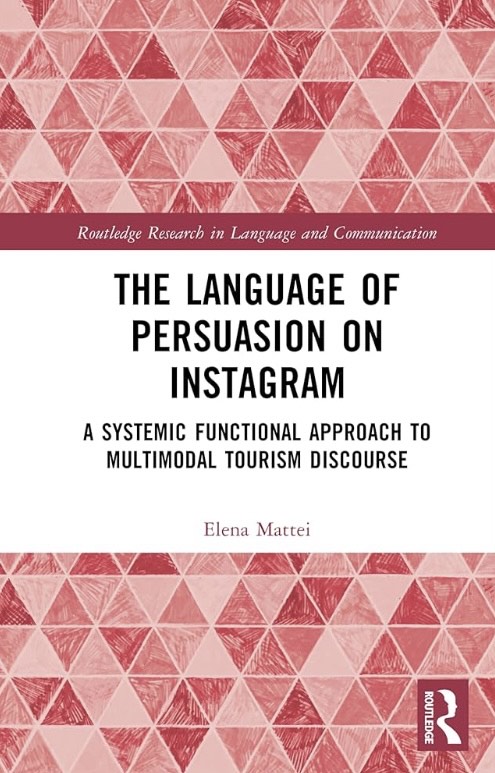
New Book: Elena Mattei, The Language of Persuasion on Instagram. A Systemic Functional Approach to Multimodal Tourism Discourse, Routledge, 2025

This book offers a systematic, interdisciplinary investigation into the language of persuasion in contemporary tourism discourse, with a focus on English-language travel boards’ use of Instagram and official websites. Drawing on Corpus Linguistics and Systemic Functional Linguistics, it examines how linguistic and visual resources are strategically deployed to construct idealized representations of destinations and evoke positive emotional responses. Through a multimodal analysis, the volume explores recurring linguistic patterns, the role of platform-specific dissemination, and how discourse constructs power dynamics between destinations and prospective tourists. By combining empirical methods with critical discourse and sociological perspectives, the book sheds light on how emotionally charged, consumer-oriented narratives may reinforce broader socioeconomic inequalities and contribute to unsustainable travel practices. In doing so, it contributes to ongoing debates on digital persuasion and literacy, media framing, and the ideological function of tourism communication, recommending approaches to integrate data-driven, highly persuasive strategies and eco-sensitive narratives. This book will be of interest to scholars and students in discourse analysis, digital communication, tourism studies, marketing, and linguistics, as well as professionals interested in the mechanisms behind strategic, promotional narratives and their potential impact on social and environmental sustainability. Elena Mattei, The Language of Persuasion on Instagram. A Systemic Functional Approach to Multimodal Tourism Discourse. Routledge  ISBN 9781032937489   288 Pages 44 B/W Illustrations

New Book: Elena Mattei, The Language of Persuasion on Instagram. A Systemic Functional Approach to Multimodal Tourism Discourse, Routledge, 2025 Read More »

Echoes of Hate, Screens of Resistance: Discourse, Media, and Pedagogy in the Digital Age

Naples, 23–25 October 2025 Università di Napoli “L’Orientale” The international conference Echoes of Hate, Screens of Resistance marks the culmination of the PRIN 2022 project ECHOES – English Studies to Contrast Hate Online and Enhance Solidarity, a multidisciplinary initiative funded by the Italian Ministry of University and Research. The project focuses on the critical analysis of harmful online practices (HOPs) in English multimodal discourse, with an emphasis on promoting solidarity, inclusion, and responsible digital citizenship. In today’s increasingly polarised digital world, hate is no longer confined to fringe communities; in fact, it circulates widely through social media, public discourse, and popular audiovisual culture. Cinema and television, together with social networking systems, participate in both the reproduction and the contestation of exclusionary narratives. Meanwhile, educational institutions face mounting pressure to equip learners and educators with tools to identify, counter, and neutralise these forms of hate. This conference provides an open platform for scholars, educators, cultural practitioners, media analysts, and digital activists to reflect on the critical role of language, screen discourse, and pedagogical practices in addressing hate and fostering inclusive futures. Over the past two years, the ECHOES project has investigated online hate from a multimodal critical discourse analysis (MCDA) perspective, analysing verbal, visual, and aural digital texts in English. Using this methodology, the interuniversity research team has identified four prominent forms of HOPs, namely trolling, cyberbullying, bashing, and defamation, and analysed their impact on four particularly vulnerable social groups: women, migrants and diasporic communities, LGBTIQ+ individuals, and people with disabilities. In addition, the analysis was guided by six main hate categories: Age (including discrimination against the elderly), Body, Disability, Ethnicity (including various forms of racism not necessarily linked to migration), Gender, and Religion.The conference will explore how digital and screen-based textualities construct and circulate hate, and how they offer discursive and pedagogical opportunities for resistance. By convening experts from fields such as applied linguistics, discourse analysis, media and film studies, education, and social semiotics, Echoes of Hate, Screens of Resistance seeks to cultivate and promote interdisciplinary dialogue and reinforce the role of education and research in countering digital toxicity. We especially encourage contributions that engage critically with the idea of digital solidarity, interrogate the ethical responsibilities of content creators and educators, and propose tangible models for promoting inclusion and mutual respect in online and audiovisual communication. Conference ThemesWe welcome proposals for individual papers, panels, and workshops on topics including, but not limited to: 1. Digital Hate Discourse• Multimodal analysis of online hate speech (HOPs) across social media platforms• Discursive strategies of exclusion and vilification in English-language digital environments• Affect, irony, humour, and other indirect forms of digital aggression and disambiguation• Corpus-informed approaches to the study of online hostility 2. Cinema and Television as Arenas of Resistance• Audiovisual representations of vulnerable communities (LGBTIQ+, migrants, women, disabled people)• Screen narratives that challenge hate and promote empathy• Subtitling, dubbing, and the translation of discriminatory ideologies• Censorship, genre, and ideology in TV and film discourse 3. Activism, Policy, and Civil Society• Best practices in hate monitoring, moderation, and civic advocacy• Pedagogies of peace and solidarity across sectors• Partnerships between researchers and public institutions• Lifelong learning and critical media literacy in local communities 4. Teacher Training Track• As part of the ECHOES project’s commitment to outreach and societal impact, the Conference will feature a dedicated Teacher Training Track on Saturday, 25th. This track will include 45-minute workshops and/or materials presentations specifically designed to support English language teachers. Aimed particularly at those working in primary and secondary education, it will offer practical insights into teaching digital literacy, global citizenship, and intercultural communication through inclusive and critical methodologies. Submission Guidelines• Abstracts (max 300 words, including references) for individual 20-minute papers must be submitted via email in English, accompanied by a brief bio (maximum 150 words).• Panel proposals (3-4 speakers) should include a panel rationale (max 300 words, including references) and individual abstracts (max 200 words each, without references). Write to: prin2022echoes@unior.it Deadline for submissions: 30th July 2025Notification of acceptance: 1st Sept. 2025Registration deadline: 30th Sept. 2025Language: English Keynote SpeakersWe are delighted to announce the participation of internationally prominent scholars:• Salvatore Attardo (Texas A&M University)• Michael Burke (Utrecht University)• Giuditta Caliendo (Université de Lille)• Majid KhosraviNik (Newcastle University) TBC• Tiziana Terranova (University of Naples L’Orientale)• Mikael Toulza (Université de Lille) Convenor:Giuseppe Balirano, University of Naples L’Orientale Scientific Committee:Maria Cristina Aiezza (University of Naples L’Orientale), Emilio Amideo (University of Naples “Parthenope”), Marta Arcovito (University of Messina), Maria Vita Cambria (University of Messina), Maria De Santo (University of Naples L’Orientale), Bianca Del Villano (University of Naples L’Orientale), Alessandra Ferlito (University of Campania Luigi Vanvitelli), Antonio Fruttaldo (Sannio University), Bronwen Hughes (University of Naples “Parthenope”), Francesco Nacchia (University of Naples L’Orientale), Marina Niceforo (University of Naples L’Orientale), Maria Cristina Nisco (University of Naples “Parthenope”), Raffaele Pizzo (University of Naples L’Orientale), Annalisa Raffone (Pegaso University), Margherita Rasulo (University of Campania Luigi Vanvitelli), Katherine Elizabeth Russo (University of Naples L’Orientale), Maria Grazia Sindoni (University of Messina), Stefania Taviano (University of Messina). Organising Committee:Mauro Brondi, Maria De Santo, Robin Donadio, Roberto Esposito, Dalia Mennella, Francesco Nacchia, Marina Niceforo, Raffaele Pizzo Venue:23–24 October 2025:San Severo al Pendino Heritage Site, The Historic SacristyVia Duomo, 286 – 80138 Naples 25 October 2025:Istituto Italiano per gli Studi Filosofici, Palazzo Serra di Cassano Via Monte di Dio, 14-15 – 80132 Naples
Echoes of Hate, Screens of Resistance: Discourse, Media, and Pedagogy in the Digital Age Read More »

Collective Biographies Across Disciplines and Ages

Women’s Studies Group 1558 – 1837 Hybrid Conference 1 July 2025 Università degli Studi di Cagliari Faculty of Humanities, Via San Giorgio 12, Aula 6 and Aula Magna The one-day conference, scheduled to take place on July 1, 2025, in Cagliari, under the joint patronage of the local Department of Lettere, Lingue, and Beni Culturali and of the Women’s Studies Group, will explore aspects of collective biographies. This label has been the subject of extensive discussion and a range of definitions among historians, literary critics, and social scientists. The University of Cagliari’s scholars will collaborate with academics and independent historians and linguists from the United Kingdom and the United States of America in an endeavour to expand the corpus and the genres of the collective biographies. The organiser, Professor Maria Grazia Dongu, is seeking to establish a new research group with a focus on this topic. Should this be of interest, please direct your correspondence to dongu@unica.it

Collective Biographies Across Disciplines and Ages Read More »

CALL FOR PAPERS COGNITION & THE MEDIA 30-31 October 2025 Università degli Studi “G. d’Annunzio di Chieti-Pescara”

Segreteria AIA 13:51 (4 ore fa) CALL FOR PAPERS: COGNITION & THE MEDIA 30-31 October 2025 Università degli Studi “G. d’Annunzio di Chieti-Pescara” We are pleased to announce the International Conference on Cognition and the Media, a multidisciplinary event bringing together scholars from media studies, cognitive science, translation studies, linguistics, psychology, and related fields. Drawing inspiration from the work of scholars such as Gilles Fauconnier, George Lakoff, Ronald W. Langacker and Mark Turner (cognitive linguistics), as well as more recent contributions by Giuseppe Balirano (digital and social media, multimodality, and multimodal stylistics), Jorge Díaz-Cintas (screen and digital media, cybersubtitling and cyberdubbing ), Yves Gambier (translation, cognition, and media accessibility) and Marcello Giovanelli (stylistics, cognitive studies, and the public humanities), the conference seeks to explore the dynamic relationship between cognitive processes and media forms — including film, television, digital platforms, games, and social media — with a particular emphasis on translation and audiovisual practices. We aim to foster dialogue on how media influence, shape, and are shaped by cognitive mechanisms such as perception, attention, memory, emotion, and narrative comprehension, especially in contexts involving multilingualism, accessibility, and intersemiotic mediation. At the heart of this conference is a key question: How do media shape and reflect the ways we think, feel, and communicate—especially across languages and cultures? In an era of saturated information, real-time interaction, and constant cross-linguistic exchange, cognition is at the centre of how media function and how meaning moves across borders. As cognitive science deepens our understanding of how we perceive, process, interpret and memorise information, it raises critical questions for media scholars, translators, and communication experts. We invite papers that explore the dynamic intersection of cognition and media from multiple disciplinary perspectives. Submissions may address (but are not limited to): Cognitive theories of media consumption and productionMedia influence on perception, attention, memory, and emotionNarrative cognition in journalism, film, and digital storytellingMultilingual media processing and translation receptionCognitive approaches to subtitling, dubbing, and voiceoverThe role of cognitive load in audiovisual translationCognitive models of narrative and storytelling in mediaEye-tracking and neurocognitive studies in translation researchEmotion and affect in digital storytellingThe cognitive impact of multilingual media environmentsTranslating culture, humour, and emotion across mediaNeurological and psychological studies of translation and media receptionPerception of Time, Technology and Media in the Imagined 19th Century“Steam-powered” Media: Print, Telecommunication, and Information ManipulationHistorical cognition and media technologies (e.g., clocks, automatons, memory devices)Artificial Memory in Alternative Worlds PROPOSALS – SUBMISSION GUIDELINESINDIVIDUAL PAPERS (20 mins) Please attach a single document including:Title and abstract of your proposal (300 words max.)5 keywordsAuthor’s name, affiliation, email address and biography (100 words max.) Email: cognition.media2025@unich.it Deadline for submissions: 22nd September 2025Notification of acceptance: 30th September 2025Registration fee deadline: 4th Octobert 2025Conference fee: 200 EUR (standard) / 150 EUR (PhD student) by 4th October 2025

CALL FOR PAPERS COGNITION & THE MEDIA 30-31 October 2025 Università degli Studi “G. d’Annunzio di Chieti-Pescara” Read More »

CALL FOR PAPERS “Passaggi di Senso: Traduzioni e Linguaggi oltre i Confini”

University of Salerno (Italy) 23-24 February 2026 The conference aims to promote interdisciplinary and multilingual reflections on the role of languages in processes of mobility, contact and mediation in contemporary global contexts. Contributions may explore a wide range of topics related to language variation, translation practices, intercultural communication and sociolinguistic dynamics in multilingual and multicultural settings. Proposals (max. 300 words) should be submitted by 15 September 2025 to convtradspec2026@unisa.it. Important dates:– Abstract submission deadline: 15 September 2025– Notification of acceptance: 31 October 2025– Full paper submission for peer-reviewed volume: 30 May 2026 The conference will be held in hybrid format (in-person and online). No registration fees are required.

CALL FOR PAPERS “Passaggi di Senso: Traduzioni e Linguaggi oltre i Confini” Read More »

CALL FOR PAPERS Convegno dottorale “Wunderkammer: Forme Linguistiche, Letterarie e Culturali del Meraviglioso” Università Roma Tre, 15 e 16 dicembre 2025

Organizzato dai dottorandi e dalle dottorande dei cicli XXXVIII e XXXIX del dottorato in Lingue, Letterature e Culture Straniere dell’Università Roma Tre, il convegno propone di indagare le declinazioni e le rappresentazioni linguistiche, letterarie e culturali dell’idea di meraviglia. Dottorande e dottorandi e giovani ricercatrici e ricercatori sono invitati a presentare proposte, in italiano o inglese, della lunghezza massima di 350 parole all’indirizzo graduate.llcs.romatre@gmail.com entro il 15 luglio 2025. È prevista la pubblicazione degli atti del convegno nella collana Xenia. Studi Linguistici, Letterari e Interculturali (Roma Tre-Press).  Proposte entro il 15 luglio 2025 (graduate.llcs.romatre@gmail.com)

CALL FOR PAPERS Convegno dottorale “Wunderkammer: Forme Linguistiche, Letterarie e Culturali del Meraviglioso” Università Roma Tre, 15 e 16 dicembre 2025 Read More »

Torna in alto