culture

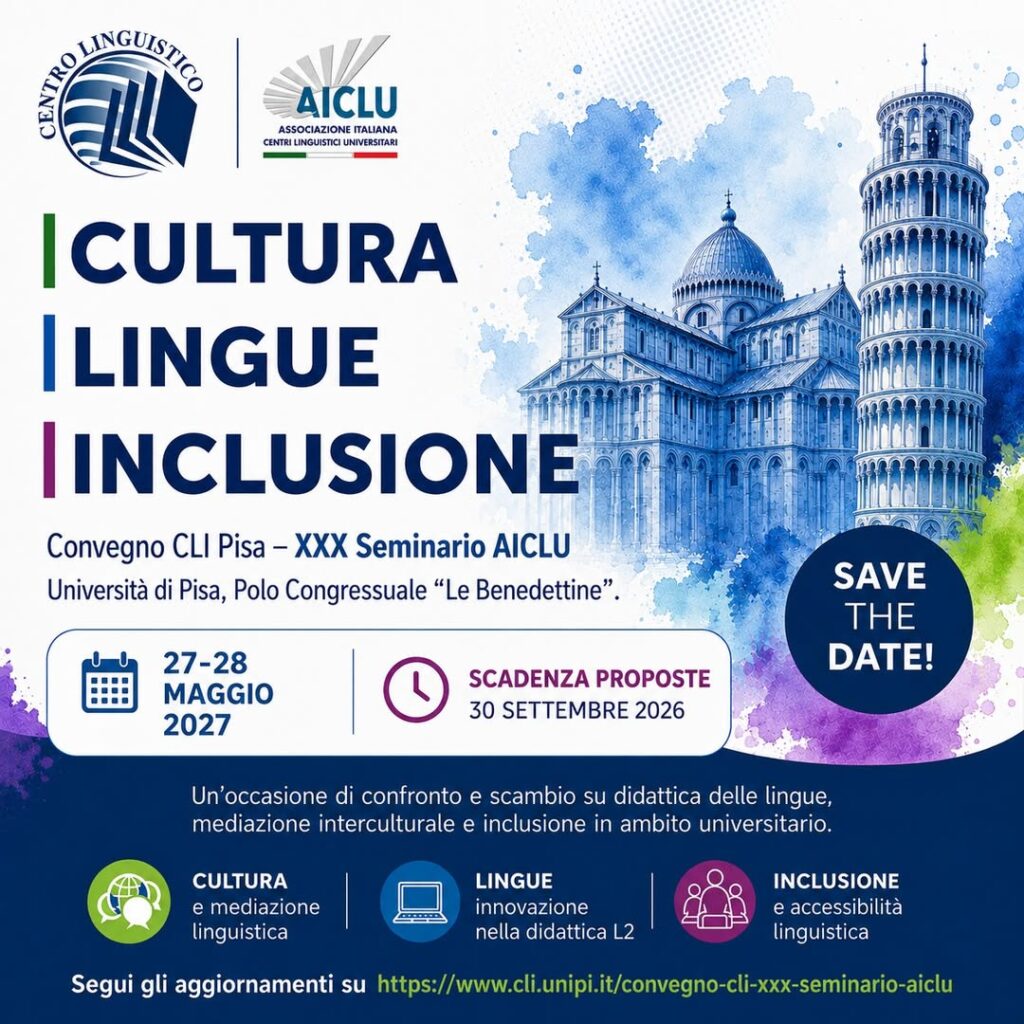
CFP Culture – Languages – Inclusion CLI Pisa Conference – 30th AICLU Seminar – University of Pisa, 27–28 May 2027

The University of Pisa Language Centre (CLI), in collaboration with the Italian Association of University Language Centres (AICLU), invites proposals for the conference Culture – Languages – Inclusion, to be held in Pisa on 27–28 May 2027. The event will also host the 30th AICLU Seminar and aims to bring the national network of university language centres into dialogue with the wider community of scholars and practitioners working in language education, intercultural mediation and inclusion. The conference addresses the changing role of language education in higher education in response to internationalisation, student mobility, digital technologies and artificial intelligence, and the growing need to ensure accessibility and participation for increasingly diverse student populations. Contributions are invited in three thematic areas: 1. Culture and Language MediationKeynote speaker: Christian Fandrych (University of Leipzig)Topics include multilingualism and multicultural identities, intercultural competence, linguistic and cultural mediation, international mobility, AI and language mediation, translation and interpreting in educational contexts, and EMI. 2. Languages: Innovation in Second Language TeachingKeynote speaker: Fanny Meunier (UC Louvain; Circle U – European University Alliance)Topics include innovative approaches to L2 teaching, digital tools, generative AI and language corpora, learner autonomy, blended and online learning, language learning in academic contexts, and the integration of formal, non-formal and informal learning. 3. Inclusion and Linguistic AccessibilityKeynote speaker: Michele Daloiso (University of Parma)Topics include inclusive language education, specific learning difficulties and other special educational needs, accessibility of teaching materials and digital platforms, assistive technologies and AI, Universal Design for Learning, inclusive assessment, and linguistic and communication accessibility. The conference welcomes theoretical, methodological and empirical contributions, as well as presentations of good practice. Submission deadline: 30 September 2026Notification of acceptance: by 30 October 2026Abstract: approximately 300 words, excluding referencesSubmission: aiclu2027@cli.unipi.it Conference website:https://www.cli.unipi.it/convegno-cli-xxx-seminario-aiclu

CFP Culture – Languages – Inclusion CLI Pisa Conference – 30th AICLU Seminar – University of Pisa, 27–28 May 2027 Read More »

CFP ESSE 2026 Seminar n. 14.- Beyond Words: Literary, Cultural, and Linguistic Multimodality in Joseph Conrad’s Narratives (deadline 31 January 2026)

14.- Beyond Words: Literary, Cultural, and Linguistic Multimodality in Joseph Conrad’s NarrativesJoseph Conrad’s narratives serve as a compelling case study for multimodal exploration, blending literary, linguistic, and cultural dimensions into rich, evocative works. This seminar examines how multimodal approaches illuminate Conrad’s complex storytelling, focusing on the interplay between linguistic structures, literary techniques, and cultural contexts. By studying works such as Heart of Darkness and Lord Jim through a multimodal lens, we uncover the myriad ways Conrad crafts narratives that resonate across boundaries of language, imagery, and ideology. From a linguistic perspective, Conrad’s use of layered language – marked by subtleties, ambiguities, and multilingual influences – offers insights into the tension between precision and interpretation, a hallmark of his writing style. For instance, the frequent inclusion of polysemous expressions and deliberate syntactic disruptions mirrors the fragmented realities his characters endure. Such linguistic strategies reflect Conrad’s own experience as a polyglot navigating cultural and linguistic hybridity, lending his texts an inherent multimodal quality. Literary criticism highlights Conrad’s innovations in narrative form and technique, such as his use of frame narratives and unreliable narrators, which invite readers to engage critically with his texts. These devices create a multimodal interplay between textual layers and meanings, fostering a dynamic interpretative process. For instance, Conrad’s frame narrative in Heart of Darkness juxtaposes oral storytelling with textual accounts, producing a narrative experience that transcends singular modalities. On a cultural level, Conrad’s thematic focus on colonialism, modernity, and existential angst provides fertile ground for multimodal analysis. The cultural contexts embedded in his works – whether through geographical descriptions, historical references, or ideological critiques – reveal a depth of engagement that transcends mere storytelling, creating a network of semiotic connections. In such context, multimodal analysis enriches traditional literary criticism by incorporating visual, auditory, and cultural dimensions, reflecting the complexity of contemporary textual interaction in an increasingly digitized and globalized world. This seminar underscores the potential to engage with recent critical approaches, highlighting how multimodal analysis aligns with contemporary emphases on interdisciplinarity, cross-cultural perspectives, and the integration of diverse media forms. By integrating linguistic precision, literary criticism, and cultural analysis, this seminar not only deepens our understanding of Conrad’s works but also underscores the significance of multimodality as a framework for exploring literature in its broadest dimensions. CONVENORS:

CFP ESSE 2026 Seminar n. 14.- Beyond Words: Literary, Cultural, and Linguistic Multimodality in Joseph Conrad’s Narratives (deadline 31 January 2026) Read More »

Torna in alto