ESSE CfP

Call for Papers – Narrating Conflict and Human Rights: Literature as Witness, Archive and Agent of Change European Journal of English Studies, volume 31 (2027)

Guest editors: Tomasz Kalaga (Kujawy and Pomorze University in Bydgoszcz), Tiziana Ingravallo (University of Foggia), Loredana Salis (University of Sassari) The realities of conflict, including violations of human rights and the struggle for peace, provide rich thematic material for literary works. Literature can serve as a powerful tool for social change by denouncing injustices, fostering empathy, and engaging with injustices via its negotiation of the concepts of truth, reconciliation, and transitional justice. Writers can challenge official narratives surrounding conflict by giving voice to marginalised perspectives, exposing human rights abuses to a wider audience, and making invisible suffering visible. Literature, as an advocate for social change and human rights, raises awareness of ongoing conflicts and offers alternative understandings of historical events and their consequences. Operating through its innate symbolic quality and the power of telling and retelling myths, it can be approached as a dynamic arena capable of unsettling dominant epistemologies, reconfiguring what could be collectively claimed as justice. As a counter-discourse to official histories, literature has the potential to offer new ways of restoring a sense of humanity and shared responsibility by condemning all forms of imperialism and totalitarianism. This issue will reflect on and explore ways in which conflict can be narrated and the extent to which texts of literature contribute to defending or violating human rights. It also reflects on how language can justify and/or ignore human rights transgressions. The issue takes an interest in articles that investigate the ability of literary texts to interrogate and explore the legacies of political and civil conflict around the world as well as creating and (unwittingly) reinforcing hegemonic narratives. We welcome essays on a wide range of genres, including fiction, poetry, drama, memoir, testimony, speculative and activist writing, as well as works in translation, adaptation, journalism, and visual or digital storytelling. Although articles can address any topic related to literature and human rights, we are keen to receive proposals on five interrelated areas of literary engagement: a) literary depictions of experiences of war, displacement, surveillance, disenfranchisement, or environmental destruction; b) the role of literature in defining and articulating the concept of justice, documenting abuses, bearing witness to trauma, and narrating resistance and reconciliation; c) literary negotiations of power dynamics in conflict settings, including propaganda literature, translation and adaptation of conflict narratives, portrayals of nationalism and resistance movements, and the symbolic language of conflict and resolution; d) the concept of literature as magistra vitae in which historical insight is intertwined with visions of a more just future; e) narrative forms shaped by conflict, including fragmented storytelling and genre innovation, as well as activist literature addressing the intersections of human rights, environmental destruction, and the more-than-human world. Possible topics include (but are not limited to): ● Activist literature: from human rights violations to environmental destruction ● Activist role of literature: models for socio-cultural transformations, inclusive societies, transnational belongings ● Beyond the anthropocentric: rights of species, rivers, forests ● Censorship and dissent: literature as subversion and alternative standpoint ● Entanglements of ecology and power: resource wars, extractivism, forced displacement ● Individual freedom and human dignity vs human rights violations, surveillance, oppression, disenfranchisement ● Journalism, conflict and human rights ● Literature and justice: shaping and reshaping the notion of what is or can be just ● Literary depictions of ecological trauma and conflict: decolonial and indigenous perspectives, ● Literature as an archive of environmental injustice: resistance narratives, testimonies and speculative fiction and non-fiction. ● Magistra vitae: when history and hope rhyme ● Narrating nationalism, nationalists and nationalist causes ● Postcolonial and decolonial perspectives: alternative epistemologies of justice, restitution, and ecological interconnectedness ● Post-traumatic memory ● Propaganda literature ● The language of conflict and conflict resolution: myths and symbols retold ● The role of human rights in research on law and literature ● Translation and adaptation Detailed proposals (up to 1,000 words) for full essays (6,000-8,000 words) as well as a short biography (max. 100 words) should be sent to the editors by 15 January 2026: Tomasz Kalaga (t.kalaga @kpsw. edu. pl), Tiziana Ingravallo (tiziana. ingravallo @unifg. it), and Loredana Salis (lsalis@uniss.it). Selected authors should be able to submit a full-length draft by the end of May 2026, and a final version by mid-September. This issue will be part of volume 31 (2027). All inquiries regarding this issue can be sent to the three guest editors.

Call for Papers – Narrating Conflict and Human Rights: Literature as Witness, Archive and Agent of Change European Journal of English Studies, volume 31 (2027) Read More »

Call for Seminar Papers 18th ESSE Conference – Seminar 21, “The Poetics and Ethics of Sexual Dissidence in Anglophone Postcolonial Literatures”

Call for Seminar Papers: Seminar 21, “The Poetics and Ethics of Sexual Dissidence in Anglophone Postcolonial teratures” Dates: August 31–September 4, 2026 Place: Santiago de Compostela, Spain Convenors: Cédric Courtois (University of Lille, France); Angelo Monaco (Aldo Moro University of Bari, Italy) We invite submissions for a panel that will examine the intersections of sexuality, identity, resistance and dissent in Anglophone postcolonial non-fiction, fiction, drama, and poetry. We wish to explore the avenues offered by literary texts to challenge and/or disrupt heteronormative and “universal” norms of gender and sexuality, by pondering over what Jonathan Dollimore calls “sexual dissidence” (1991), linked to a form of transgressivity. In so doing, these texts can be considered as “political”, if we follow Jacques Rancière, for whom “dissensus” is at the heart of “politics” (2010). To what extent do these literary texts shed light on other modes of being that interrogate the legacies of colonialism? By adopting a decolonial perspective, which lays bare the “colonial wound”, could Anglophone literatures delve into ways of reaching “decolonial healings” (Mignolo and Vazquez 2013)? As David L. Eng puts it, sexual dissidence and other forms of intimacy can work as “sites of critical response” (2010) for addressing the challenges of race in the so-called “colorblind” age of global capitalism. By staging vulnerable, “precarious” (Butler 2004) and “ungrievable” (Butler 2009) lives, embodied and “willful” (Ahmed 2014) lives even, at the intersection of race, gender and sexuality, these texts can be said to resist censorship, the law, and more generally “queer” invisibilisation. In this light, the focus on sexual dissidence could lead to what Emmanuel Renault calls “recognition” (2001), especially for LGBTQIA2S+ people who tend to be stigmatized; the lack of “recognition” can be “experience[d] […] as real moral wounds[,] [t]he experience of [which] is painful and radical enough to lead to a revolt” (Renault 2001). Building on these insights, this panel will strive to elucidate how Anglophone postcolonial literatures help cultivate an ethics and a poetics of sexual dissidence, serving as an archive of (cultural) resistance. Deadline for the submission of proposals for seminar papers: January 31, 2026. Send to: cedric.courtois@univ-lille.fr, angelo.monaco@uniba.it Further information at: www.esse2026.com Dates: August31–September 4, 2026Place: Santiagode Compostela, SpainConvenors:Cédric Courtois (University of Lille, France); Angelo Monaco (Aldo MoroUniversity of Bari, Italy)Deadline for thesubmission of proposals for seminar papers: January 31, 2026. Send to: cedric.courtois@univ-lille.fr, angelo.monaco@uniba.it Furtherinformation at: www.esse2026.com We invitesubmissions for a panel that will examine the intersections of sexuality,identity, resistance and dissent in Anglophone postcolonial non-fiction,fiction, drama, and poetry. We wish to explore the avenues offered by literarytexts to challenge and/or disrupt heteronormative and “universal” norms ofgender and sexuality, by pondering over what Jonathan Dollimore calls “sexualdissidence” (1991), linked to a form of transgressivity. In so doing, thesetexts can be considered as “political”, if we follow Jacques Rancière, for whom“dissensus” is at the heart of “politics” (2010). To what extent do these literary texts shed light on other modesof being that interrogate the legacies of colonialism? By adopting a decolonialperspective, which lays bare the “colonial wound”, could Anglophone literaturesdelve into ways of reaching “decolonial healings” (Mignolo and Vazquez 2013)?As David L. Eng puts it, sexual dissidence and other forms of intimacy can workas “sites of critical response” (2010) for addressing the challenges of race inthe so-called “colorblind” age of global capitalism. By staging vulnerable,“precarious” (Butler 2004) and “ungrievable” (Butler 2009) lives, embodied and“willful” (Ahmed 2014) lives even, at the intersection of race, gender andsexuality, these texts can be said to resist censorship, the law, and moregenerally “queer” invisibilisation. In this light, the focus on sexualdissidence could lead to what Emmanuel Renault calls “recognition” (2001),especially for LGBTQIA2S+ people who tend to be stigmatized; the lack of“recognition” can be “experience[d] […] as real moral wounds[,] [t]heexperience of [which] is painful and radical enough to lead to a revolt”(Renault 2001). Building on these insights, this panel will strive to elucidatehow Anglophone postcolonial literatures help cultivate an ethics and a poeticsof sexual dissidence, serving as an archive of (cultural) resistance.

Call for Seminar Papers 18th ESSE Conference – Seminar 21, “The Poetics and Ethics of Sexual Dissidence in Anglophone Postcolonial Literatures” Read More »

Call for Seminar Papers Disinformation in and out: Qualitative Linguistic Analyses of Digital Disinformation Texts 18th ESSE Conference 31st August-4th September 2026 Santiago de Compostela, Spain

Convenors:Dominika Beneš Kováčová (University of Ostrava, Czech Republic)dominika.kovacova@osu.czMassimiliano Demata (University of Catania, Italy) massimiliano.demata@unict.itJiří Lukl (University of Ostrava, Czech Republic) jiri.lukl@osu.cz With the challenges and crises of recent years, digital disinformation texts (in popular – though not always precise – usage also referred to as ‘fake news’) have become increasingly popular and seem to have gained ground among various groups of internet users. Defined as “false information [that] is knowingly shared to cause harm” (Wardle & Derakhshan, 2017), disinformation is essentially the result of one’s text production – shaped by the author’s intentions that manifest themselves in the text’s intentionality (cf. Haugh & Jaszczolt, 2012) – and its spread is contingent on the readers’perception and further interaction with it. While previous (primarily quantitative) studies of disinformation texts have mainly focused on disinformation detection by identifying recurrent grammatical patterns and stylistic features (e.g., Grieve & Woodfield, 2023), this seminar seeks to bring together contributions that expand this research and underline the relevance and potential of qualitative analyses of disinformation discourse currently on the rise (e.g., Maci et al., 2024). Acknowledging the methodological and ethical challenges this kind of research faces, the seminar takes into account the diversity of the topics disinformation texts are devoted to (e.g., immigration, conflicts, climate change, conspiracy theories) as well as the variety of their discursive structures and formats (e.g., anti-establishment websites, social media posts, online broadcasts). Given the impact disinformation texts are likely to exert both online and outside the digital environment, the seminar also aims to emphasize that adding a critical dimension to the analysis may be necessary in certain contexts. Considering the above, we invite contributions exploring disinformation texts from a qualitative linguistic perspective that address (but are not restricted to) the following areas: – recurrent linguistic and multimodal strategies– adopted argumentative strategies– linguistic differences between mainstream news and disinformation texts (e.g., information-structural, lexical and other features)– uptake and audience reactions to disinformation texts– cross-linguistic differences between disinformation texts References:Grieve, J., & Woodfield, H. (2023). The Language of Fake News. Cambridge University Press.Haugh, M., & Jaszczolt, K. M. (2012). Speaker Intentions and Intentionality. In K. Allan and K. M. Jaszczolt (Eds.), The Cambridge Handbook of Pragmatics (pp. 87-122). Cambridge University Press.Maci, S. M., Demata, M., McGlashan, M., & Seargeant, P. (Eds.). (2024). The Routledge Handbook of Discourse and Disinformation. Routledge. https://doi.org/10.4324/9781003224495Wardle, C., & Derakhshan, H. (2017). Information Disorder: Toward an Interdisciplinary Framework for Research and Policy Making. Council of Europe. https://edoc.coe.int/en/media/7495-information-disorder-toward-an-interdisciplinary-framework-for-research-and-policy-making.html Deadline for the submission of proposals for seminar papers (300 words excl.bibliographical references) to seminar convenors: 31 January 2026For further information, see the conference website: www.esse2026.com

Call for Seminar Papers Disinformation in and out: Qualitative Linguistic Analyses of Digital Disinformation Texts 18th ESSE Conference 31st August-4th September 2026 Santiago de Compostela, Spain Read More »

CALL FOR PAPERS for Volume 30 of the European Journal of English Studies to be published in 2026

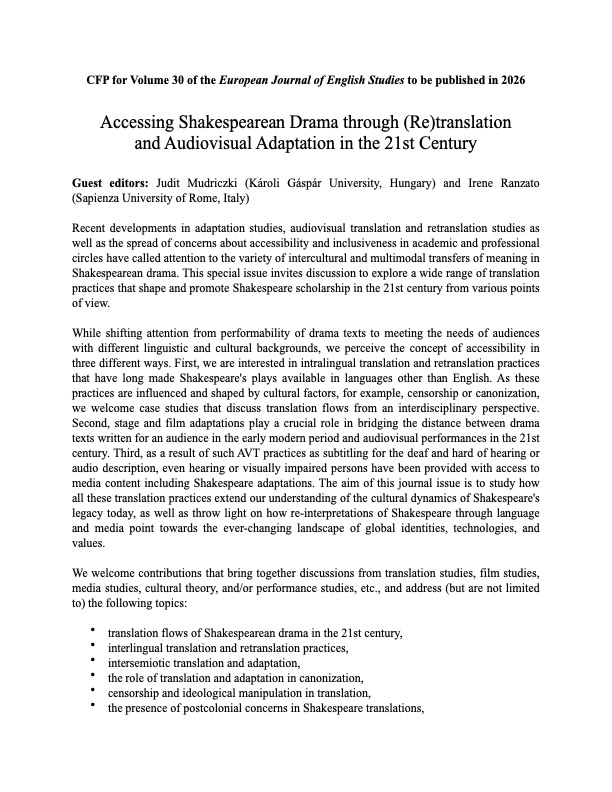
Accessing Shakespearean Drama through (Re)translation and Audiovisual Adaptation in the 21st Century Guest editors: Judit Mudriczki (Károli Gáspár University, Hungary) and Irene Ranzato (Sapienza University of Rome, Italy)Recent developments in adaptation studies, audiovisual translation and retranslation studies as well as the spread of concerns about accessibility and inclusiveness in academic and professional circles have called attention to the variety of intercultural and multimodal transfers of meaning in Shakespearean drama. This special issue invites discussion to explore a wide range of translation practices that shape and promote Shakespeare scholarship in the 21st century from various points of view. While shifting attention from performability of drama texts to meeting the needs of audiences with different linguistic and cultural backgrounds, we perceive the concept of accessibility inthree different ways. First, we are interested in intralingual translation and retranslation practices that have long made Shakespeare’s plays available in languages other than English. As these practices are influenced and shaped by cultural factors, for example, censorship or canonization, we welcome case studies that discuss translation flows from an interdisciplinary perspective. Second, stage and film adaptations play a crucial role in bridging the distance between drama texts written for an audience in the early modern period and audiovisual performances in the 21st century. Third, as a result of such AVT practices as subtitling for the deaf and hard of hearing or audio description, even hearing or visually impaired persons have been provided with access to media content including Shakespeare adaptations. The aim of this journal issue is to study how all these translation practices extend our understanding of the cultural dynamics of Shakespeare’s legacy today, as well as throw light on how re-interpretations of Shakespeare through language and media point towards the ever-changing landscape of global identities, technologies, and values. We welcome contributions that bring together discussions from translation studies, film studies, media studies, cultural theory, and/or performance studies, etc., and address (but are not limited to) the following topics: • translation flows of Shakespearean drama in the 21st century,• interlingual translation and retranslation practices,• intersemiotic translation and adaptation,• the role of translation and adaptation in canonization,• censorship and ideological manipulation in translation,• the presence of postcolonial concerns in Shakespeare translations,• inclusiveness and media accessibility of Shakespeare adaptations,• audiovisual translation practices of screen adaptations,• audio description and subtitling of Shakespeare on screen,• surtitling Shakespeare performances. Detailed proposals (up to 1,000 words) for full essays (approx. 7,500 words), as well as a short biography (max.100 words) should be sent to both editors by 20 April 2025: Judit Mudriczki (mudriczki.judit@kre.hu) and Irene Ranzato (irene.ranzato@uniroma1.it) EJES operates in a two-stage review process.1. Contributors are invited to submit proposals for essays on the topic in question by 20 April 2025.2. Following review of the proposals by the editorial board panel, informed by external specialists as appropriate, the guest editors will invite the authors of short-listed proposals to submit full-length essays for review with a summer 2025 deadline.3. The full-length essays undergo a second round of review, and a final selection for publication is made. Selected essays are revised and then resubmitted to the guest editors in late 2025 for publication in 2026. EJES employs Chicago Style (T&F Chicago AD) and British English conventions for spelling. For more information about EJES, see: http://www.essenglish.org/ejes.html and https://[www.tandfonline.com/toc/neje20/current]www.tandfonline.com/toc/neje20/current

CALL FOR PAPERS for Volume 30 of the European Journal of English Studies to be published in 2026 Read More »

ESSE Conference – 26-30 August 2024

ESSE Conference European Society for the Study of English 2024 conference http://www.unil.ch/esse2024 The 2024 European Society for the Study of English conference will take place at the University of Lausanne, Switzerland, 26-30 August 2024. Call for posters, seminar papers and doctoral symposium Posters should be devoted to research-in-progress and project presentations. The aim is to provide additional opportunities for feedback and personal contacts. At the conference, there will be a dedicated poster session, which is scheduled to take place on Tuesday 27 August 2024 at 6pm. Please send proposals of not more than 240 words to esse2024@unil.ch by 31 January 2024. Seminar papers Scholars wishing to present their paper in one of the seminars are invited to submit 250- word abstracts of their proposed presentations and a brief bio directly to the convenors of the respective seminars by 31 January 2024. The list of seminars can be found here: https://wp.unil.ch/esse2024/calls-for-participation/call-forindividual-papers-and-posters/ Seminars consist of a varying number of academic papers and discussions. The length of papers should be 20 minutes with an added 10 minutes for discussion. As the number of slots for seminars is restricted for room reasons, the seminar convenors have some flexibility and may ask seminar participants for shortened papers in order to allow for more presentations in their seminars. Doctoral Symposium Call for participation at: https://wp.unil.ch/esse2024/calls-for-participation/callfor-the-doctoral-symposium/ KEY DATES 31 January 2024: Submissions of proposals for individual papers and posters 31 January 2024: Application to Doctoral Symposium 1 March 2024: Registration begins

ESSE Conference – 26-30 August 2024 Read More »

Call for individual paper and poster presentations for ESSE 2020 – Lyon, France (31 August-4 September)

ESSE 2020 Conference in Lyon, France (31s August – 4 September 2020) Vincent Renner, for the Organizing Committee, wishes to let it be known that the call for individual paper and poster presentations for ESSE 2020 is now online at http://www.esse2020lyon.fr/…/esse-2020-call-for-paper-and-p… Seminar papers Scholars wishing to present their papers at the ESSE 2020 Conference are invited to submit abstracts of 200/250 words directly to the convenors of the targeted seminars by 15 January 2020. Posters Posters are to be devoted to research-in-progress and project presentations. Abstracts of 200/250 words should be sent to esse2020lyon@gmail.com by 15 January 2020 and will be reviewed by the Academic Programme Committee.

Call for individual paper and poster presentations for ESSE 2020 – Lyon, France (31 August-4 September) Read More »

Call for Contributions: ESSE Messenger Summer 2019

The ESSE Messenger invites contributors to submit professional articles to the Summer 2019 issue of the ESSE Messenger. The ESSE Messenger is an EBSCOHOST and ERIHPLUS indexed journal, listed at DUOTROPE. This issue’s topic is a very challenging one: “The Reality and Permanence of Fantasy Fiction”. New deadline: 15 May 2019. Details at: http://essenglish.org/messenger/cfps/

Call for Contributions: ESSE Messenger Summer 2019 Read More »

Torna in alto