upcoming

CALL FOR PAPERS COGNITION & THE MEDIA 30-31 October 2025 Università degli Studi “G. d’Annunzio di Chieti-Pescara”

Segreteria AIA 13:51 (4 ore fa) CALL FOR PAPERS: COGNITION & THE MEDIA 30-31 October 2025 Università degli Studi “G. d’Annunzio di Chieti-Pescara” We are pleased to announce the International Conference on Cognition and the Media, a multidisciplinary event bringing together scholars from media studies, cognitive science, translation studies, linguistics, psychology, and related fields. Drawing inspiration from the work of scholars such as Gilles Fauconnier, George Lakoff, Ronald W. Langacker and Mark Turner (cognitive linguistics), as well as more recent contributions by Giuseppe Balirano (digital and social media, multimodality, and multimodal stylistics), Jorge Díaz-Cintas (screen and digital media, cybersubtitling and cyberdubbing ), Yves Gambier (translation, cognition, and media accessibility) and Marcello Giovanelli (stylistics, cognitive studies, and the public humanities), the conference seeks to explore the dynamic relationship between cognitive processes and media forms — including film, television, digital platforms, games, and social media — with a particular emphasis on translation and audiovisual practices. We aim to foster dialogue on how media influence, shape, and are shaped by cognitive mechanisms such as perception, attention, memory, emotion, and narrative comprehension, especially in contexts involving multilingualism, accessibility, and intersemiotic mediation. At the heart of this conference is a key question: How do media shape and reflect the ways we think, feel, and communicate—especially across languages and cultures? In an era of saturated information, real-time interaction, and constant cross-linguistic exchange, cognition is at the centre of how media function and how meaning moves across borders. As cognitive science deepens our understanding of how we perceive, process, interpret and memorise information, it raises critical questions for media scholars, translators, and communication experts. We invite papers that explore the dynamic intersection of cognition and media from multiple disciplinary perspectives. Submissions may address (but are not limited to): Cognitive theories of media consumption and productionMedia influence on perception, attention, memory, and emotionNarrative cognition in journalism, film, and digital storytellingMultilingual media processing and translation receptionCognitive approaches to subtitling, dubbing, and voiceoverThe role of cognitive load in audiovisual translationCognitive models of narrative and storytelling in mediaEye-tracking and neurocognitive studies in translation researchEmotion and affect in digital storytellingThe cognitive impact of multilingual media environmentsTranslating culture, humour, and emotion across mediaNeurological and psychological studies of translation and media receptionPerception of Time, Technology and Media in the Imagined 19th Century“Steam-powered” Media: Print, Telecommunication, and Information ManipulationHistorical cognition and media technologies (e.g., clocks, automatons, memory devices)Artificial Memory in Alternative Worlds PROPOSALS – SUBMISSION GUIDELINESINDIVIDUAL PAPERS (20 mins) Please attach a single document including:Title and abstract of your proposal (300 words max.)5 keywordsAuthor’s name, affiliation, email address and biography (100 words max.) Email: cognition.media2025@unich.it Deadline for submissions: 22nd September 2025Notification of acceptance: 30th September 2025Registration fee deadline: 4th Octobert 2025Conference fee: 200 EUR (standard) / 150 EUR (PhD student) by 4th October 2025
CALL FOR PAPERS COGNITION & THE MEDIA 30-31 October 2025 Università degli Studi “G. d’Annunzio di Chieti-Pescara” Read More »

CALL FOR PAPERS “Passaggi di Senso: Traduzioni e Linguaggi oltre i Confini”

University of Salerno (Italy) 23-24 February 2026 The conference aims to promote interdisciplinary and multilingual reflections on the role of languages in processes of mobility, contact and mediation in contemporary global contexts. Contributions may explore a wide range of topics related to language variation, translation practices, intercultural communication and sociolinguistic dynamics in multilingual and multicultural settings. Proposals (max. 300 words) should be submitted by 15 September 2025 to convtradspec2026@unisa.it. Important dates:– Abstract submission deadline: 15 September 2025– Notification of acceptance: 31 October 2025– Full paper submission for peer-reviewed volume: 30 May 2026 The conference will be held in hybrid format (in-person and online). No registration fees are required.

CALL FOR PAPERS “Passaggi di Senso: Traduzioni e Linguaggi oltre i Confini” Read More »

CALL FOR PAPERS Convegno dottorale “Wunderkammer: Forme Linguistiche, Letterarie e Culturali del Meraviglioso” Università Roma Tre, 15 e 16 dicembre 2025

Organizzato dai dottorandi e dalle dottorande dei cicli XXXVIII e XXXIX del dottorato in Lingue, Letterature e Culture Straniere dell’Università Roma Tre, il convegno propone di indagare le declinazioni e le rappresentazioni linguistiche, letterarie e culturali dell’idea di meraviglia. Dottorande e dottorandi e giovani ricercatrici e ricercatori sono invitati a presentare proposte, in italiano o inglese, della lunghezza massima di 350 parole all’indirizzo graduate.llcs.romatre@gmail.com entro il 15 luglio 2025. È prevista la pubblicazione degli atti del convegno nella collana Xenia. Studi Linguistici, Letterari e Interculturali (Roma Tre-Press).  Proposte entro il 15 luglio 2025 (graduate.llcs.romatre@gmail.com)

CALL FOR PAPERS Convegno dottorale “Wunderkammer: Forme Linguistiche, Letterarie e Culturali del Meraviglioso” Università Roma Tre, 15 e 16 dicembre 2025 Read More »

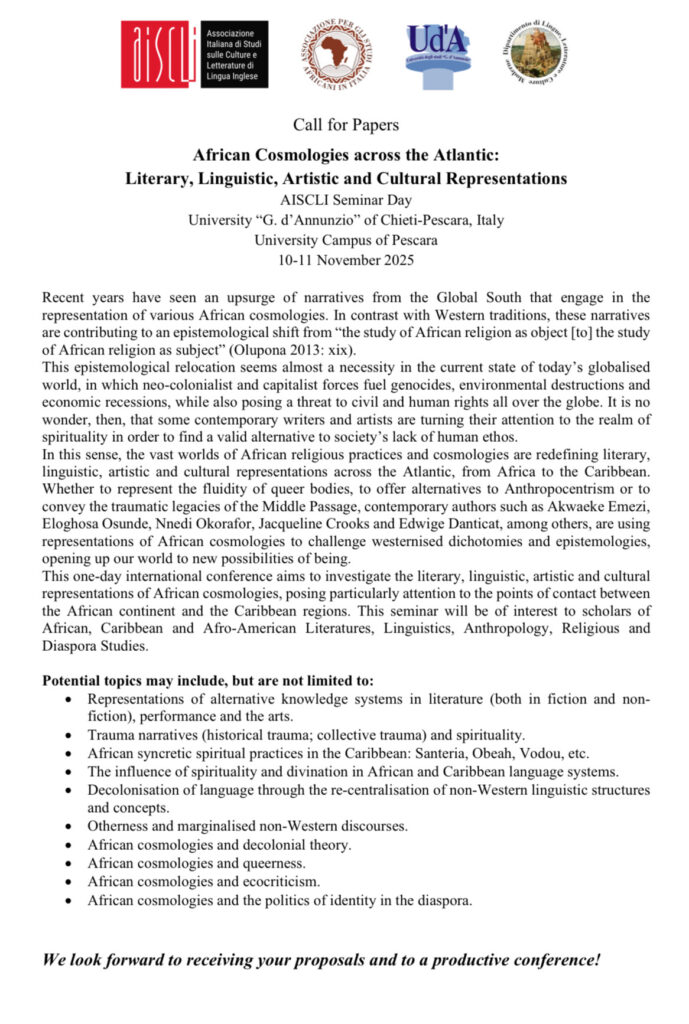
CALL FOR PAPERS African Cosmologies across the Atlantic: Literary, Linguistic, Artistic and Cultural Representations AISCLI Seminar Days

University “G. d’Annunzio” of Chieti-Pescara, ItalyUniversity Campus of Pescara10-11 November 2025 Recent years have seen an upsurge of narratives from the Global South that engage in the representation of various African cosmologies. In contrast with Western traditions, these narratives are contributing to an epistemological shift from “the study of African religion as object [to] the study of African religion as subject” (Olupona 2013: xix). This epistemological relocation seems almost a necessity in the current state of today’s globalised world, in which neo-colonialist and capitalist forces fuel genocides, environmental destructions and economic recessions, while also posing a threat to civil and human rights all over the globe. It is no wonder, then, that some contemporary writers and artists are turning their attention to the realm of spirituality in order to find a valid alternative to society’s lack of human ethos. In this sense, the vast worlds of African religious practices and cosmologies are redefining literary, linguistic, artistic and cultural representations across the Atlantic, from Africa to the Caribbean. Whether to represent the fluidity of queer bodies, to offer alternatives to Anthropocentrism or to convey the traumatic legacies of the Middle Passage, contemporary authors such as Akwaeke Emezi, Eloghosa Osunde, Nnedi Okorafor, Jacqueline Crooks and Edwige Danticat, among others, are using representations of African cosmologies to challenge westernised dichotomies and epistemologies, opening up our world to new possibilities of being. This one-day international conference aims to investigate the literary, linguistic, artistic and cultural representations of African cosmologies, posing particular attention to the points of contact between the African continent and the Caribbean regions. This seminar will be of interest to scholars of African, Caribbean and Afro-American Literatures, Linguistics, Anthropology, Religious and Diaspora Studies. Potential topics may include, but are not limited to:• Representations of alternative knowledge systems in literature (both in fiction and non-fiction), performance and the arts.• Trauma narratives (historical trauma; collective trauma) and spirituality.• African syncretic spiritual practices in the Caribbean: Santeria, Obeah, Vodou, etc.• The influence of spirituality and divination in African and Caribbean language systems.• Decolonisation of language through the re-centralisation of non-Western linguistic structures and concepts.• Otherness and marginalised non-Western discourses.• African cosmologies and decolonial theory.• African cosmologies and queerness.• African cosmologies and ecocriticism.• African cosmologies and the politics of identity in the diaspora. We look forward to receiving your proposals and to a productive conference! Submission GuidelinesWe invite proposals for individual papers that address these and related topics. Proposals should include an abstract of around 250 words and a brief biographical statement of no more than 100 words.Prospective contributors should send their abstracts to africancosmologies@gmail.com DeadlinesDeadline for abstract submission: 15/07/2025Notification of acceptance: 30/07/2025Final programme: 31/08/2025 Scientific CommitteeCarmen Concilio (University of Turin, Italy)Mariaconcetta Costantini (University “G. d’Annunzio” of Chieti-Pescara)Pietro Deandrea (University of Turin, Italy)Alessandra Di Maio (University of Palermo, Italy)Maria Paola Guarducci (Roma Tre University, Italy)Mara Mattoscio (“Guglielmo Marconi” University, Italy)Valerio Pisaniello (University “G. d’Annunzio” of Chieti-Pescara)Nicoletta Vallorani (University of Milan, Italy) Organising CommitteeAminat Emma Badmus (University of Modena and Reggio Emilia)Alessandra Di Pietro (University “G. d’Annunzio” of Chieti-Pescara) Lisbety Mirabal Díaz (University “G. d’Annunzio” of Chieti-Pescara)

CALL FOR PAPERS African Cosmologies across the Atlantic: Literary, Linguistic, Artistic and Cultural Representations AISCLI Seminar Days Read More »

Tennis in Literature and Film Brescia, 16-17 April 2026 CFP

While Sinner-mania is steadily growing in Italy, a measure of the global hype surrounding tennis isthe proliferation in the past few years of literary and cinematic representations of this game. FromAndre Agassi’s bestselling autobiography Open to the recent success of Luca Guadagnino’sChallengers, tennis occupies a central place in contemporary pop culture. Yet these are only thelatest expressions of an artistic tradition as old as the sport itself, encompassing film and theatre,‘high’ literature (think of Giorgio Bassani’s The Garden of the Finzi-Continis or David FosterWallace’s Infinite Jest) and commercial fiction (such as Sophie Kinsella’s debut novel, The TennisParty, and Taylor Jenkins Reid’s Carrie Soto Is Back), life writing and journalis – not to mentiontennis fanatics like Samuel Beckett, Vladimir Nabokov, and Martin Amis.This conference aims to investigate the forms and modes of representation of tennis – both in itsmodern version and in its early manifestations – in world literature, cinema, and TV series. It willalso be the opportunity to promote the impressive tennis library and archive built by Italian TVcommentator, journalist, and writer Gianni Clerici (1930-2022), now held at Università Cattolica delSacro Cuore in Brescia (https://brescia-raccoltestoriche-gianniclerici.unicatt.it/).We welcome 20-minute papers in English or Italian from academics as well as journalists andtennis experts. Topics may include, but are not limited to:

Tennis in Literature and Film Brescia, 16-17 April 2026 CFP Read More »

CFP Inheriting Eco. Umberto Eco, the University of Bologna and all the knowledge in the world

Alma Mater Studiorum – Università di Bologna 27-29 May 2026 (opens on 26 May) The year 2026 will mark the 10th anniversary of Umberto Eco’s death on 19 February 2016. Ten years during which Eco himself had asked not to organise any conferences about him, so as to better determine and appreciate what to forget, what to keep, and what to build on. Indeed, a decade is an adequate time span to allow culture to fulfil two of its essential functions, adopted by Eco as central themes of his essays: that of filtering knowledge, offering subsequent generations only that which deserves to be remembered, and of opening, or renewing, a text through new interpretations. Two actions that, alone, serve to appreciate what can and must remain. This conference on the 10th anniversary of Eco’s death, which the Alma Mater Studiorum – Università di Bologna is promoting through its Centro internazionale di Studi umanistici “Umberto Eco”, aims to make Umberto Eco’s intellectual legacy visible, inviting participants to shape the conference with the ambition of developing a scientific event that is genuinely close to Umberto Eco’s way of thinking. By bringing together scholars in the many fields of knowledge in which Eco worked, the conference aims to bring out Eco’s legacy of thought; the aspects that emerge following the progress and distance brought about by ten years; the elements of thought that are still worthy of attention; and the directions in which these elements can be developed and relaunched today. This conference, therefore, has no set themes or sub-themes for reflection; instead, it makes room for the most important themes to emerge from the papers, debate and work of the scholars summoned to Bologna. In short, the Centro internazionale di Studi umanistici “Umberto Eco” is organising an open work-conference enabling the emergence of new paths of reflection by re-examining and re-filtering Umberto Eco’s immense body of works. The proposals should be structured around six main areas: With these areas in mind, those who identify with one or more of Eco’s ideas will be able to interact and reflect dialogically with the conference’s community of scholars. In doing so, not only will the conference redesign a legacy destined to become ever richer and more open; it will also make it possible to commemorate Eco’s vast intellectual legacy of thought in a non-ceremonial manner, revealing its strength, renewing its interpretation, and creating an occasion that is not merely commemorative or retrospective, but rich in thought, innovation and future. Organisational instructions We invite researchers wishing to participate in the conference to submit their proposal by 30 October 2025. The proposal should include:  The official website of the conference, through which proposals can be submitted, will be available from the end of May 2025. The Scientific Committee of the Conference will notify acceptance of the proposal by 30 November 2025. The conference languages are Italian and English. Consequently, the proposal should also be drafted in one of these two languages. The maximum duration of each speech is 20 minutes. Enrolment If the proposal is accepted, its submission requires advance payment of the registration fee. Registration fees Registration includes access to all keynote lectures and all convention and social events organised as part of the conference. More information will be available soon on the official website of the conference:

CFP Inheriting Eco. Umberto Eco, the University of Bologna and all the knowledge in the world Read More »

Torna in alto