Nome dell'autore: Anglistica

proroga VQR – messaggio del Presidente AIA

Care socie, cari soci,l’ANVUR ha comunicato che la scadenza della presentazione delle candidature come revisore esterno per la VQR 2020-2024 è stata prorogata al 3 giugno 2025, ore 23:59. Tutte le informazioni sulla proroga sono disponibili presso questo:  E’ possibile presentare la propria candidatura presso questo link: https://auth.miur-legacy.cineca.it/auth/realms/Anvur/protocol/openid-connect/auth?response_type=code&scope=openid&client_id=dfe&state=d1jxYJt49YMJzR93aOD9qdldMGk&redirect_uri=https%3A%2F%2Fesperti-anvur.bandi.cineca.it%2Foauth2%2Fredirect_uri&nonce=C5VWHiWSZRTfV3sPwtftb2xraiyCb9IScWK2WQxc_BYLa procedura richiede tempo, ma in realtà nella domanda ci sono solo alcuni campi obbligatori, ad esempio: “E’ richiesta la compilazione della descrizione relativa ai principali risultati scientifici conseguiti negli ultimi 10 anni.”  Gli altri campi descrittivi, relativi a progetti di ricerca e premi, sviluppo reti e relazioni scientifiche, supporto alla comunità scientifica, valorizzazione delle conoscenze, sono FACOLTATIVI. Invitiamo pertanto i soci e le socie che posseggono i requisiti a completare la loro domanda al più presto. 

proroga VQR – messaggio del Presidente AIA Read More »

International PhD Programme: Studies in English Literatures, Language and Translation (SELLT) Administrative Headquarters: Sapienza University of Rome Sapienza Partner Institution (Dual Degree): University of Silesia, Katowice, Poland

International PhD Programme: Studies in English Literatures, Language and Translation (SELLT) Administrative Headquarters: Sapienza University of Rome Partner Institution (Dual Degree): University of Silesia, Katowice, Poland The SELLT PhD Programme is aimed at highly motivated students interested in pursuing an interdisciplinary path in English Studies, within an academic community that fosters strong international connections. Courses and seminars are held at the Marco Polo Building, located in the San Lorenzo district of Rome, a vibrant and well-equipped academic hub offering libraries, a cafeteria, study areas, and recreational spaces. SELLT programme promotes the development of advanced critical and analytical skills and supports high-level research in English linguistics, translation studies, English and AngloAmerican literature, as well as related cultural and disciplinary areas. The PhD programme is structured into three specialized curricula:1. Linguistics and Translation Studies2. Literary Studies – Anglo-American Literature and Culture3. Literary Studies – English Literature and Culture   SELLT offers a research environment designed to build solid theoretical foundations, develop teaching skills, and foster in-depth analysis in the following areas: • The history and periodization of English and Anglo-American literature, with a focus on stylistic, cultural, and epistemological aspects across different eras, including the contemporary period • Literary theory and critical methodologies, including comparative approaches and dialogue with European literatures • Linguistic analysis of literary and non-literary texts through tools from contemporary stylistics and discourse analysis • Theories, methods, and approaches from Translation and Adaptation Studies, with special attention to the developments of the past four decades • Historical linguistics and pragmatics in the study of the English language • Applied linguistics with a focus on English Language Teaching (ELT)   Research projects are especially encouraged in the following areas: William Shakespeare and dramatic language Shakespearean textual philology 21st-century theatre studies North American literary and non-literary texts Colonial and post-colonial culture    Within the field of Translation Studies:     o Literary translation     o Audiovisual translation     o Translation and accessibility     o Adaptation Studies     o History of translation Multilingualism and diatopic variation in synchronic and diachronic perspective Humour Studies History of the English language Textual analysis, Contemporary stylistics and historical pragmatics English Language Teaching (ELT) Please, check here for the formal announcement and all relevant information.

International PhD Programme: Studies in English Literatures, Language and Translation (SELLT) Administrative Headquarters: Sapienza University of Rome Sapienza Partner Institution (Dual Degree): University of Silesia, Katowice, Poland Read More »

AIA 32 in Turin is over… see you in Rome in two years for our next AIA Conference! And thank you to Virginia Pulcini and to all the AIA members and Turin staff and students for a splendid event!

The 32nd AIA Conference: Human, Humane, Humanities. Voices from the Anglosphere (11-13 September 2025) has been a great success! Thank you to Virginia Pulcini and to all the members, students and everybody else involved in the splendid organization… https://corep.it/aia-conference-2025

AIA 32 in Turin is over… see you in Rome in two years for our next AIA Conference! And thank you to Virginia Pulcini and to all the AIA members and Turin staff and students for a splendid event! Read More »

Letteratura e musica: fare l’Irlanda, fare gli irlandesi

Da sempre Ireland è la “land of song”, la terra in cui si celebra il connubio perfetto tra musica e poesia. Da tempo immemorabile Éire è il simbolo della “minstrelsy”, il paradiso dei menestrelli, protagonisti seducenti ed imprevedibili della vita di corte, capaci di incarnare e fondere testualità complesse e complementari, verbali e musicali. Tra XVI e XVII secolo, Geoffrey Keating (1569-1644) ricordò che, fin dalle epoche più remote della sua storia, Eire declinò persino le proprie consuetudini giuridiche, mediche, sociali, politiche in componimenti poetici messi in musica. Proprio a tale vocazione musico-letteraria fecero riferimento anche Thomas Davis (1814-1845) quando propose “a book of ballad and songs” come esito di quella che considerava la “first faculty of the Irish” e come strumento per la costituzione della propria nazione. Il Prof. Enrico Reggiani (per info: enrico.reggiani@unicatt.it) ne ragionerà in tre incontri che si terranno a Chieti-Pescara e Milano nei prossimi giorni.

Letteratura e musica: fare l’Irlanda, fare gli irlandesi Read More »

Seminario AICLU Didattica delle Lingue Straniere: nuove tecnologie per una didattica più inclusiva e sostenibile – Ferrara 26-27 maggio 2025

Il prossimo Seminario AICLU 2025 si terrà a Ferrara dal mattino del 26 maggio 2025 al pomeriggio del 27 maggio 2025, nella splendida cornice di Palazzo Turchi di Bagno, in Corso Ercole I d’Este 32, 44121 Ferrara.  Link all’evento: Link al programma:   Per qualsiasi ulteriore informazione, scrivete a seminarioAICLU2025@unife.it.

Seminario AICLU Didattica delle Lingue Straniere: nuove tecnologie per una didattica più inclusiva e sostenibile – Ferrara 26-27 maggio 2025 Read More »

CFP EASA Conference 2025 Minding the Present: Bodies, Places, Matter in and between Australia and Europe 17-19 September 2025 Department of Linguistic and Literary Studies, University of Padova

CALL FOR CONFERENCE PAPERS Minding the Present: Bodies, Places, Matter in and between Australia and Europe (EASA Conference) 17-19 September 2025  Department of Linguistic and Literary Studies, University of Padova (Via Vendramini, 13, Padova, Italy) We are pleased to announce the call for papers for the conference Minding the Present: Bodies, Places, Matter in and between Australia and Europe, to be held on 17-19 September 2025, at the University of Padova (Italy). In this conference we aim to explore the demands of the present, the actions and interactions we are all bound to set into motion in order to engage in political and art-activistic practices to start caring for and curing our vulnerable planet and our insecure standing on and with it. Central to our exploration is the ontology of the present—the hic et nunc (here and now)—together with the concepts of present orientation and the re-figurations of time/s. We will focus on how, through discourse, art, literature and geopolitical praxis, we can understand, experience, and potentially reshape both our perception of time, particularly in relation to the present moment. We are especially interested in investigating the present as a dynamic space situated between archives of the past (Hall, 2001) and what P. Saint-Amour has defined as traumatic anticipations of the future (Saint-Amour, 2015), taking into account nonlinear, non-Western and Indigenous cosmologies and heterotopias. In this way, we assert that, as Hodgson suggests, “the present moment is not… a static fixed coalescence but a super complexity, the dynamism of which determines its ability for anticipation” (2013, p. 31).   We seek to examine the shaping experiences, identities, and perceptions of the present as a catalyst to urgent action both in Australia—with a special alertness to the very rooted cultures of Indigenous Australia—and in the complex relations between Europe and Australia. The conference particularly welcomes contributions from literature, linguistics, the performing arts, anthropology, cultural geography, memory studies, political and legal studies. We also encourage interdisciplinary and cross-disciplinary approaches.  Among the questions that contributions may address, we would be interested in the following ones: We invite contributions that address the following topics (but are not limited to them): We particularly encourage papers that explore the interplay between archives of the past, the present moment, and anticipations of the future, examining how these temporal dimensions interact in the Australian and Australia-Europe contexts, especially those that draw from literature, the performing arts, anthropology, postcolonial studies, gender studies, trauma and disability studies, politics and legal studies. References: Augé, M., The Future, London, Verso, 2014 Hall, S., “Constituting an Archive”, Third Text, 15(54), 2001, pp. 89–92  Hodgson, A., “Towards an Ontology of the Present Moment”, On the Horizon, 21(1), pp. 24-38 Jameson, J., A Singular Modernity. Essay on the Ontology of the Present, London, Verso, 2002 Saint-Amour, P., Tense Future. Modernism, Total War, Encyclopedic Form, Oxford, Oxford University Press, 2015 Deadlines: Abstract (300-400 words) and a short bionote (200 words):  8 June 2025 Notification of acceptance: 20 June 2025 Registration (open from 2 July) (please note that panelists must be or become regular EASA members) Early bird 2-25 July 2025 200 euros 25 August-14 September 2025 280 euros PhD students: 100 euros Students and PhD students of the University of Padova: no fees Fees include coffee and lunch breaks, plus a conference set.  The conference dinner will take place on 18 September (more info on costs and the location will be offered at a later stage on the dedicated website). Scientific Committee: Dany Adone, Valérie-Anne Belleflamme, Salhia Ben-Messahel, Matthew Graves, Marie Herbillon, Irma Krčan, Maggie Nolan, Claudia Novosivschei, Marilena Parlati, Iva Polak, Geoff Rodoreda, Astrid Schwegler Castañer  Organising Committee: Maria Renata Dolce (University of Lecce), Eleonora Federici (University of Ferrara), Francesca Mussi (University of Pisa), Marilena Parlati (University of Padova) The Conference website is under construction, more information will be posted on the EASA website. The Conference is meant as an in-person event for accepted speakers, but the conference will be available on zoom for external attendees.  Contact: marilena.parlati@unipd.it (for proposals, please use the heading “EASA 2025 Padova”)
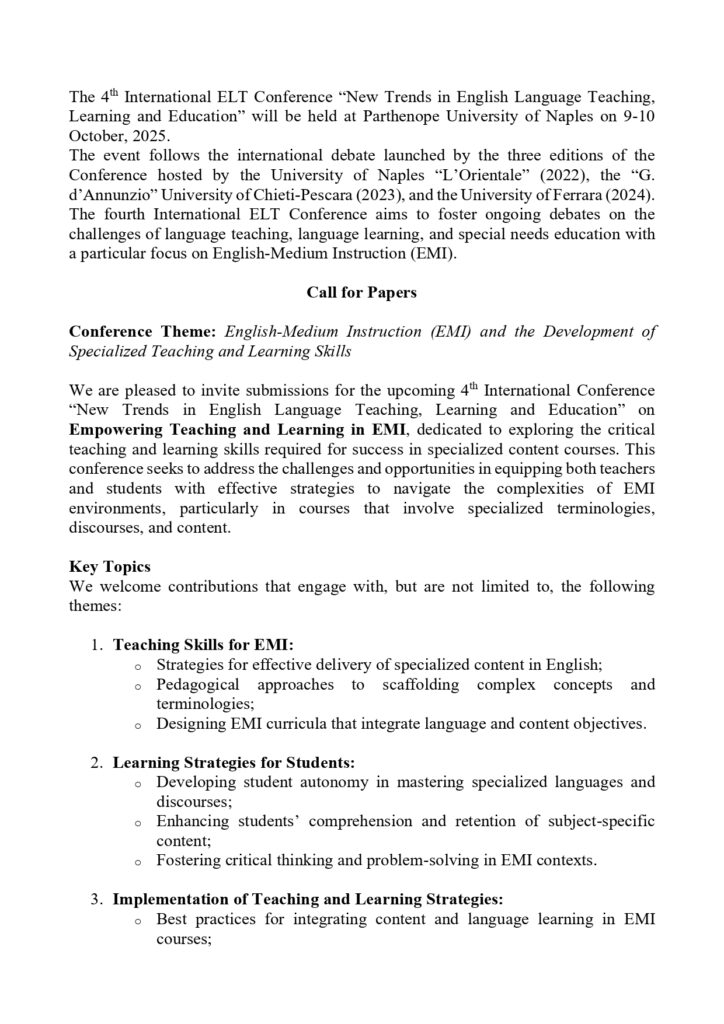
CFP EASA Conference 2025 Minding the Present: Bodies, Places, Matter in and between Australia and Europe 17-19 September 2025 Department of Linguistic and Literary Studies, University of Padova Read More »

CFP From the European South Issue 19 | Special Issue: Dark Tourism in Colonial, Postcolonial and Decolonial Contexts: Topographies of Suffering, Narrative Constructions and the Consumption of Place(s) | Fall 2026

Guest Editors: Eleonora Federici (University of Ferrara) and Marilena Parlati (University ofPadova) From the European South invites submissions for a special issue dedicated to exploring dark tourism in colonial, postcolonial and decolonial contexts, with a particular focus on the role literature, language, museum culture and storytelling in general may have in representing, but also cordoning off, global topographies of suffering, such as sites of catastrophes, genocide, environmental change and neocolonial exploitation. The editors of this issue aim to critically examine the complex relationships between dark tourism and colonial legacies, postcolonial realities and imagined communities, and also the possibilities entailed by decolonization processes. We specifically seek contributions that analyze how dark tourism sites are experienced, consumed and represented, especially in relation to the Global South.With reference to publications about dark tourism (Lennon and Foley, Dark Tourism, the Attraction of Death and Disaster 2000; Sion, Death Tourism Disaster as Recreational Landscape 2014), we wish to analyse how sites associated with death and disaster (assassination, slavery, genocide, war, tragic events) become tourist attractions. Linguistic, visual and multimodal elements help to create a representation of these sites as places of memory, education, but also, quite controversially, leisure.We are also interested in the ways in which the consumption of ‘shadow zones’ shapes these processes, both in the present and in a future-oriented perspective. We are aware that no singling out of ‘one’ memory is less than intensely debatable, since any past idea about national memory as cohesive and intrinsic has luckily often – although not everywhere – been dismantled. Thus, we would also welcome papers that help usher in discussions on the risk that memory sites (dark, in particular) may serve to reinforce overpowering ‘invented traditions’ and monolingual master narratives (see Derrida, The Monolingualism of the Other 1998). We suggest a few potential areas of focus which include, but are not limited to:● The influence of literature on the experience, interpretation and discursiverepresentation of dark tourism sites● The impact of colonial and postcolonial literatures on dark tourism site representationand vice versa● The role of fiction and non-fiction in shaping visitor expectations and experiences● Written narratives, on-site storytelling, multi-format (including digital) narratives indark tourism● Digital consumption of dark tourism places: virtual tours and social mediarepresentations● Linguistic and multimodal strategies in tourism texts (on site texts; leaflets,brochures, websites, blogs, social media)● The role of art and tourism discourse in commemorating and interpreting sites oftrauma, also in relation to reconciliation processes● Resistance, resurgence and/or reconciliation in dark tourism sites: mappingtopographies of suffering in colonial and postcolonial contexts● Tourism and postcolonial memory: the commodification of traumatic pasts, and therole of dark tourism in (postcolonial) nation-building and place branding● Indigenous tourism and dark sites: negotiating consumption, sacredness, andresistance● Shadow zones: Conflicting narratives and dissonant memories in colonial,postcolonial, decolonial dark tourism sites● ‘Authenticity’ and staged experiences in colonial/postcolonial/neocolonial darktourism sites● Intergenerational transmission of guilt, shame, and responsibility through darktourism● Dissonant memories: managing, re-presenting, revisiting conflicting historicalnarratives● Indigenous cosmologies and their integration in (or exclusion from) dark tourismnarratives We welcome contributions from various disciplines, including but not limited to: anthropology, cultural studies, gender studies, geography, history, literary studies, media studies, museum and heritage studies, philosophy, political science, postcolonial studies, religious studies, sociolinguistics, sociology, translation studies, tourism studies, urban planning. Please submit your abstract (500 words) and a brief bionote by Wednesday 1 October 2025 to both Eleonora Federici (eleonora.federici@unife.it) and Marilena Parlati (marilena.parlati@unipd.it).Notification of acceptance will be communicated by Monday 1 December 2025, with completed papers due 1 March 2026. FES 19 will be published in Fall 2026. https://www.fesjournal.eu/call/issue-19-special-issue-dark-tourism-in-colonial-postcolonial-and-decolonial-contexts-topographies-of-suffering-narrative-constructions-and-the-consumption-of-places-fall-2026/

CFP From the European South Issue 19 | Special Issue: Dark Tourism in Colonial, Postcolonial and Decolonial Contexts: Topographies of Suffering, Narrative Constructions and the Consumption of Place(s) | Fall 2026 Read More »

Torna in alto