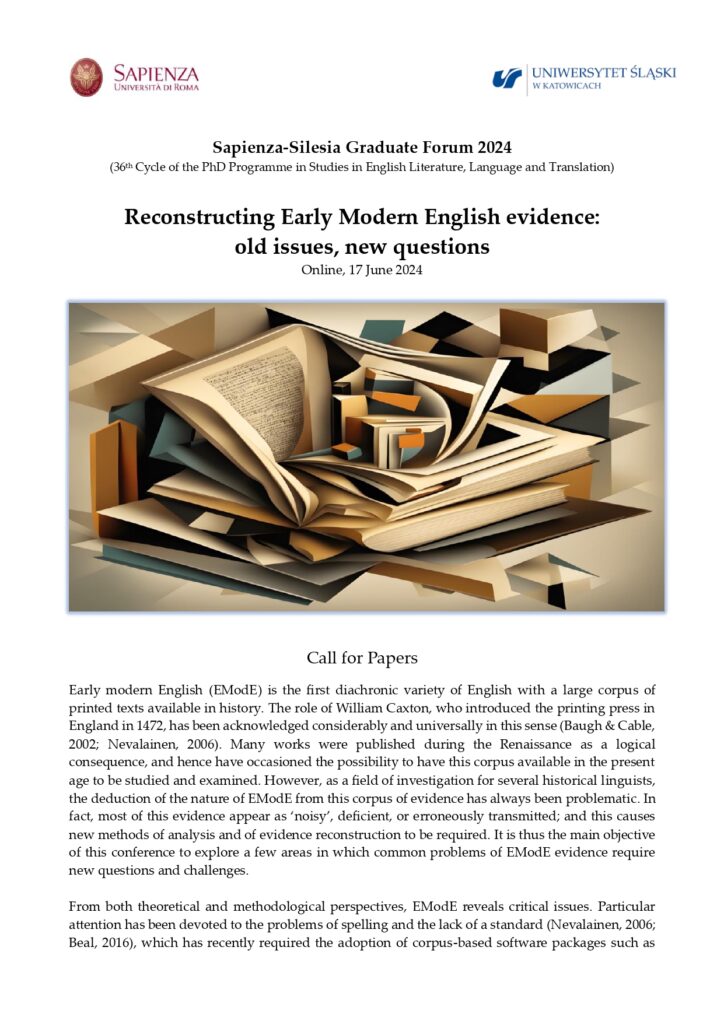
Call for Papers – Reconstructing Early Modern English evidence: old issues, new questions (online, 17 june 2024)

CALL FOR PAPERS Reconstructing Early Modern English evidence: old issues, new questions (online, 17 june 2024) Early modern English (EModE) is the first diachronic variety of English with a large corpus of printed texts available in history. The role of William Caxton, who introduced the printing press in England in 1472, has been acknowledged considerably and universally in this sense (Baugh & Cable, 2002; Nevalainen, 2006). Many works were published during the Renaissance as a logical consequence, and hence have occasioned the possibility to have this corpus available in the present age to be studied and examined. However, as a field of investigation for several historical linguists, the deduction of the nature of EModE from this corpus of evidence has always been problematic. In fact, most of this evidence appear as ‘noisy’, deficient, or erroneously transmitted; and this causes new methods of analysis and of evidence reconstruction to be required. It is thus the main objective of this conference to explore a few areas in which common problems of EModE evidence require new questions and challenges. From both theoretical and methodological perspectives, EModE reveals critical issues. Particular attention has been devoted to the problems of spelling and the lack of a standard (Nevalainen, 2006; Beal, 2016), which has recently required the adoption of corpus-based software packages such as VARD2 (Baron, 2011) to normalise historical texts; this has improved significantly the investigation of this diachronic variety of English as well as the statistical manipulation of data retrieved from historical corpora of English respectively (Baron, Rayson & Archer, 2009). In this sense, the issue of data accuracy has been central in the application of corpus linguistics as a method to explore wide range of texts and as a discipline to be theoretically enhanced (Davies, 2015). Following this, the quantitative analysis of data has been implemented in the study of EModE and has consequently boosted the observation of trends in the diachronic development of the same variety (Jenset & McGillivray, 2017). These new methodological frontiers have contributed enormously to the review of past research and to the exploration of new fields of application, especially in specialized discourses (Gotti, 2005), e.g., the investigation of EModE medical discourse (Taavitsainen & Pahta, 2010). Another interesting area is the EMod phonology, which is no foreign country. It has been the subject of many studies, contemplating the Great Vowel Shift − pivotal for an understanding of the evolution of sounds in the period − but not limiting themselves to it (e.g. Barber, 1998; Gorlach, 1991; Nevailanen, 2006). Quite recently, some EMod sounds have even been utilised in theatrical experiments. In fact, Original Pronunciation (OP) − David Crystal’s reconstruction of the sounds ascribable to Shakespeare’s time and works − was adopted in productions such as “Romeo and Juliet” (2004) and “Troilus and Cressida” (2005) at Shakespeare’s Globe. Though still little investigated in relation to present-day performances (e.g. Crystal 2005), Crystal’s OP has the merit of having fostered research into the use of “usual speech” (Massai, 2020) and the accents of early modern performers (Venegas Meza, 2022). Yet the actual accentual dimension of Shakespeare’s is still in need of exploration. Against this backdrop, the first aim of this conference is to illustrate the state of the art of the critical issues in the study of EModE as a diachronic and diaphasic variety here presented, considering the question of how to exploit collected data in the production of evidence to provide a snapshot of EModE synchronically and to reconstruct its diachronic development between 1500 and 1700. Secondly, this conference will shed light on both natural, stage and foreign accents as put on by actors in the early modern period, and even to go beyond the latter by speculating – through, say, semi-phonetic spelling – on sounds and accents inferable from literary and scientific texts published between 1500 and 1700. Contributions from PhD candidates in the fields of early modern English are welcomed. Topics can include, but are not limited to: – corpus linguistics as a method to collect data in the study of early modern English. – quantitative analysis applied to the historical analysis of early modern English. – early modern English specialized discourses. – the problem of spelling and the importance of a standard in early modern English. – the segmental and suprasegmental dimensions, and the original pronunciation. – sociolinguistic practices in theatre. – pronunciation inferable from poems, diaries, letters, essays, treatises. Presentations will be delivered in English. Please send proposals/abstracts in English of no more than 250/300 words to the Organisers (reconstructingemee@gmail.com) by 30 April 2023. Proposals should be formatted as .doc or as .pdf and include the following information: title of the presentation, a brief outline of the topic, name of the speaker, professional affiliation, and email address. In addition, please include a short professional biography of no more than 100 words. Proposals will be evaluated by both the Organising and Scientific Committees and notifications of acceptance sent out by 16 May 2023. Accepted papers will be allocated a 30-minute slot, 20 minutes for presentation and 10 for discussion. Full presentations will not be required in advance of the event. The conference will be held online on 17 June 2024. Participation is free of charge. For further inquiries, please email the Organising Committee at reconstructingemee@gmail.com. Important dates • Submission Deadline: 30 April 2024 • Notification of Acceptance: 15 May 2024 • Conference Date: 17 June 2024 Organising Committee: Emiliana Russo and Remo Appolloni Scientific Committee: Faculty Board of the PhD Programme

Call for Papers – Reconstructing Early Modern English evidence: old issues, new questions (online, 17 june 2024) Read More »

AIA for PhD – Sapienza Università di Roma (15 marzo 2024, ore 10,30)

AIA for PhD a Sapienza Università di Roma “Peer reviews and other wonderful adventures”, Riccardo Capoferro e Carmen Gallo (Sapienza) in conversazione con ospiti, dottorandi e giovani ricercatrici venerdì 15 marzo 2024 – ore 10,30 Sapienza Marco Polo – III piano – Sala Riunioni 2   Nel pomeriggio le dottorande e i dottorandi incontreranno il direttivo AIA presso Sapienza Università di Roma – Sede di Marco Polo: Circonvallazione Tiburtina 4 Roma (Nota Bene: in taxi o guidati da Google Maps indicare l’indirizzo: Scalo San Lorenzo 76). Si raccomanda la presenza, ma per chi volesse collegarsi, questo è il link Google: https://meet.google.com/khg-vkyw-thm

AIA for PhD – Sapienza Università di Roma (15 marzo 2024, ore 10,30) Read More »

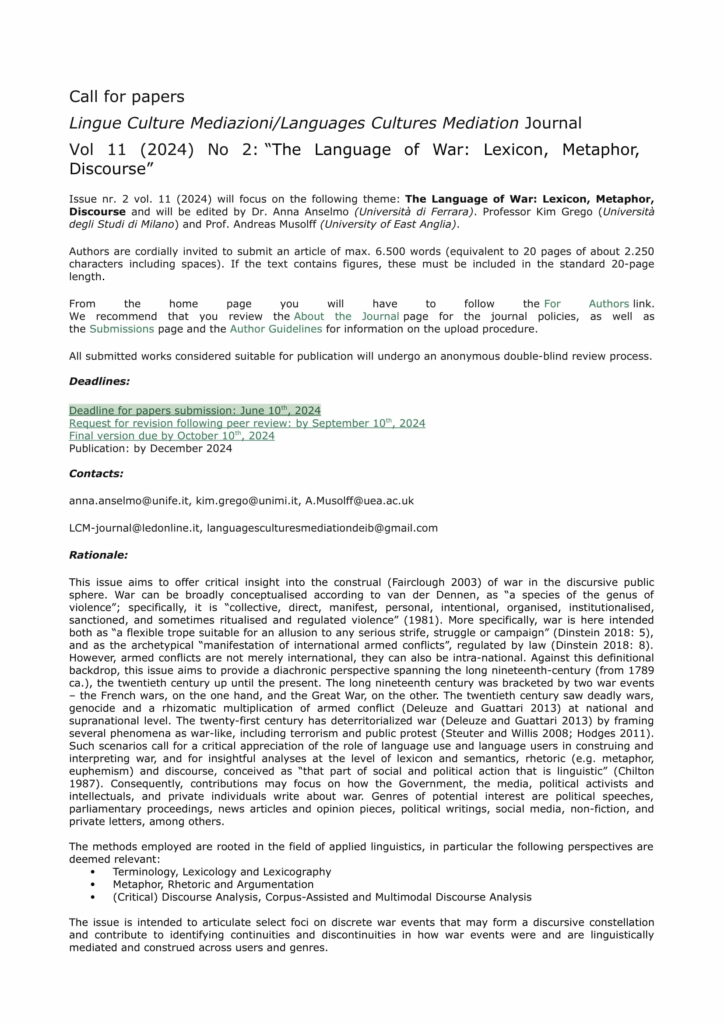
CfP Lingue “Culture Mediazioni/Languages Cultures Mediation Journal”: “The Language of War: Lexicon, Metaphor, Discourse”

Call for papers Lingue Culture Mediazioni/Languages Cultures Mediation Journal Vol 11 (2024) No 2: “The Language of War: Lexicon, Metaphor, Discourse” Issue nr. 2 vol. 11 (2024) will focus on the following theme: The Language of War: Lexicon, Metaphor, Discourse and will be edited by Dr. Anna Anselmo (Università di Ferrara). Professor Kim Grego (Università degli Studi di Milano) and Prof. Andreas Musolff (University of East Anglia). Authors are cordially invited to submit an article of max. 6.500 words (equivalent to 20 pages of about 2.250 characters including spaces). If the text contains figures, these must be included in the standard 20-page length. From the home page you will have to follow the For Authors link.We recommend that you review the About the Journal page for the journal policies, as well as the Submissions page and the Author Guidelines for information on the upload procedure. All submitted works considered suitable for publication will undergo an anonymous double-blind review process. Deadlines: Deadline for papers submission: June 10th, 2024Request for revision following peer review: by September 10th, 2024Final version due by October 10th, 2024Publication: by December 2024 Contacts: anna.anselmo@unife.it, kim.grego@unimi.it, A.Musolff@uea.ac.uk LCM-journal@ledonline.it, languagesculturesmediationdeib@gmail.com Rationale: This issue aims to offer critical insight into the construal (Fairclough 2003) of war in the discursive public sphere. War can be broadly conceptualised according to van der Dennen, as “a species of the genus of violence”; specifically, it is “collective, direct, manifest, personal, intentional, organised, institutionalised, sanctioned, and sometimes ritualised and regulated violence” (1981). More specifically, war is here intended both as “a flexible trope suitable for an allusion to any serious strife, struggle or campaign” (Dinstein 2018: 5), and as the archetypical “manifestation of international armed conflicts”, regulated by law (Dinstein 2018: 8). However, armed conflicts are not merely international, they can also be intra-national. Against this definitional backdrop, this issue aims to provide a diachronic perspective spanning the long nineteenth-century (from 1789 ca.), the twentieth century up until the present. The long nineteenth century was bracketed by two war events – the French wars, on the one hand, and the Great War, on the other. The twentieth century saw deadly wars, genocide and a rhizomatic multiplication of armed conflict (Deleuze and Guattari 2013) at national and supranational level. The twenty-first century has deterritorialized war (Deleuze and Guattari 2013) by framing several phenomena as war-like, including terrorism and public protest (Steuter and Willis 2008; Hodges 2011). Such scenarios call for a critical appreciation of the role of language use and language users in construing and interpreting war, and for insightful analyses at the level of lexicon and semantics, rhetoric (e.g. metaphor, euphemism) and discourse, conceived as “that part of social and political action that is linguistic” (Chilton 1987). Consequently, contributions may focus on how the Government, the media, political activists and intellectuals, and private individuals write about war. Genres of potential interest are political speeches, parliamentary proceedings, news articles and opinion pieces, political writings, social media, non-fiction, and private letters, among others. The methods employed are rooted in the field of applied linguistics, in particular the following perspectives are deemed relevant: The issue is intended to articulate select foci on discrete war events that may form a discursive constellation and contribute to identifying continuities and discontinuities in how war events were and are linguistically mediated and construed across users and genres. Keywords: Corpus-Assisted Discourse Studies, (Critical) Discourse Analysis, Multimodality, Terminology, Historical Lexicography, War, Conflict. Bibliography Blaxill, L. (2020). The War of Words: The Language of British Elections 1880-1914. Boydell & Brewer. Chilton, P. (1987). Metaphor, Euphemism and the Militarization of Language. Current Research on Peace and Violence, 10(1), 7–19. https://www.jstor.org/stable/40725053 Chilton, P. A. (Ed.). (1998). Political Discourse in Transition in Europe 1989 – 1991. Benjamins. Deleuze, G., Guattari, F., & Massumi, B. (2013). A Thousand Plateaus: Capitalism and Schizophrenia. Bloomsbury Academic. Dinstein, Y. (2018). War, Aggression, and Self-Defence, 6th Edition. Cambridge University Press. Fairclough, N. (2003). Analysing Discourse: Textual Analysis for Social Research. Routledge. Hayes, N., & Hill, J. (Eds.). (1999). Millions Like Us?: British Culture in the Second World War (DGO-Digital original). Liverpool University Press. https://www.jstor.org/stable/j.ctt5vjdhc Heer, H. et al. (Eds.). (2008). The Discursive Construction of History: Remembering the Wehrmacht’s War of Annihilation. Palgrave Macmillan. Hodges, A. (2011). The “War On Terror” Narrative: Discourse and Intertextuality in the Construction and Contestation of Sociopolitical Reality. Oxford University Press. Hodges, A. (2015). War Discourse. In K. Tracy, T. Sandel, & C. Ilie (Eds.), The International Encyclopedia of Language and Social Interaction (1st ed., pp. 1–6). Wiley. https://doi.org/10.1002/9781118611463.wbielsi026 Jackson, R. (2005). Writing the War on Terrorism: Language, Politics, and Counter-Terrorism. Manchester University Press. Kelly, M., Footitt, H. & Salama-Carr, M. (Eds.). (2019). The Palgrave Handbook of Languages and Conflict. Palgrave Macmillan. Kennedy, C. (2013). Narratives of The Revolutionary and Napoleonic Wars: Military and Civilian Experience in Britain and Ireland. Palgrave Macmillan. Pratt, M. L. (2009). Harm’s Way: Language and the Contemporary Arts of War. PMLA/Publications of the Modern Language Association of America, 124(5), 1515–1531. https://doi.org/10.1632/pmla.2009.124.5.1515 Russell, G. (1995). The Theatres of War: Performance, Politics, and Society, 1793-1815. Clarendon Press ; New York : Oxford University Press. Steuter, E., & Wills, D. (2008). At War with Metaphor: Media, Propaganda, and Racism in the War On Terror. Lexington Books. Thorne, S. (2006). The Language of War. Routledge. Walker, J., & Declercq, C. (Eds.). (2021). Multilingual Environments in the Great War. Bloomsbury Academic.

CfP Lingue “Culture Mediazioni/Languages Cultures Mediation Journal”: “The Language of War: Lexicon, Metaphor, Discourse” Read More »

Unimi, Sesto San Giovanni, 23 febbraio 2024

Care colleghe, cari colleghi. Come preannunciato, il prossimo incontro macro-regionale del Direttivo AIA con dottorande e dottorandi e giovani ricercatrici e ricercatori si terrà il 23 febbraio  2024 presso il Polo di Sesto San Giovanni di UNIMI, Piazza Indro Montanelli 1, in aula P2 L’incontro sarà preceduto da un momento di formazione con due interventi delle colleghe Stefania Maci e Nicoletta Vallorani, organizzato come segue: 10.30 Stefania Maci (Università degli Studi di Bergamo): English Corpus Linguistics. Research, methodological approaches, bias. 11.30 Nicoletta Vallorani (Università degli Studi di Milano): Atlanti per mondi difficili. I confini permeabili dei Cultural Studies; A seguire, a partire dalle 14 e sino alle 15.30 circa, giovani ricercatori e ricercatrici, assegnisti e assegniste, dottorande e dottorande sono invitati a partecipare a un incontro che, sulla scia dei precedenti tenutisi a Torino (dicembre 2023) e Napoli (gennaio 2024), intende favorire uno scambio ampio sull’Associazione, le sue iniziative e la sua missione. Sarà possibile partecipare all’evento anche da remoto, connettendosi a questa riunione Teams.  Chiediamo cortesemente ai partecipanti di segnalarci la loro partecipazione (in presenza o da remoto) compilando questo form.Vi preghiamo di diffondere inoltrando a tutti i possibili interessati. Cari saluti dal Direttivo AIA

Unimi, Sesto San Giovanni, 23 febbraio 2024 Read More »

Convegno dottorale: PAROLE, COSE E SIMBOLI TRA ANTICHE E NUOVE RAPPRESENTAZIONI DEL REALE

Nella società di oggi, in bilico tra reale e virtuale, il legame tra parole e cose necessita di essere riesplorato e divenire oggetto di nuove riflessioni. Lingua, letteratura e filosofia contribuiscono a pari merito a definire l’ambito del reale: la lingua concorre a definire la visione del mondo di una comunità di parlanti e allo stesso tempo muta in relazione ai cambiamenti socio-politici e tecnologici; la letteratura contemporanea, come un prisma, continua a rifrangere gli sguardi restituendo un mondo dalle mille sfaccettature; infine la filosofia per sua stessa costituzione si rivolge al reale, determinandolo e delimitandolo, costituendolo e talvolta negandolo, eleggendo la questione del rapporto tra pensiero ed essere a sua autentica domanda guida. Il Convegno interdisciplinare del Dottorato in Studi Umanistici dell’Università degli Studi di Palermo invita alla riflessione intorno ai concetti di percezione, rappresentazione e interpretazione della realtà secondo prospettive linguistiche, letterarie e filosofiche. In ambito linguistico, l’approccio Wörter und Sachen (H. Schuchardt e R. Meringer) nei primissimi anni del ’900 ha impresso agli studi linguistici una svolta decisiva, sostenendo la necessità di non disgiungere, nelle indagini lessicali ed etimologiche, lo studio delle parole da quello delle cose e dei fatti che denotano. Con l’avvento dell’intelligenza artificiale, la lingua è coinvolta in un nuovo spazio: le parole vengono rielaborate da nuovi strumenti informatici dando vita a inedite dimensioni linguistiche fra uomo e macchina, mondo reale e virtuale. Inoltre, la presenza migrante mette in discussione lo spazio linguistico nazionale (De Mauro, 1980), ridefinendo i confini tra spazio urbano, parole, significati e identità. Le “lingue migranti”, infatti, pongono in essere la questione dell’alterità e di come i regimi di mobilità abbiano dato luogo a un nuovo spazio pubblico condiviso, che necessita di nuove strategie comunicative e di integrazione. Anche in ambito educativo vengono a crearsi nuove problematiche relative ai mutamenti linguistici e culturali che la didattica delle lingue deve affrontare, proponendo metodologie inclusive che rispondano alle esigenze degli apprendenti. Seguendo questa prospettiva, si pongono alcuni interrogativi: in che misura la lingua rappresenta una trasposizione del reale nell’immaginario collettivo e quanto incarna la visione del mondo di un determinato gruppo sociale? In che misura la lingua rispecchia l’evoluzione sociale sia nella dimensione orale che in quella scritta? Questi motivi spingono il traduttore, prima di intraprendere la traduzione di un testo dalla lingua source alla lingua cible, a scegliere quale strategia applicare: domestication vs foreignization (Venuti, 1995). A partire da queste sollecitazioni, i contributi da proporre possono esplorare, senza limitarsi ad essi, l’ambito dell’onomastica (nuova e vecchia rappresentazione verbale delle persone e dei luoghi, spazio e collettività); dell’etimologia/lessicografia (vecchi e nuovi modi per rappresentare le cose tra origine del nome e referente etnolinguistico); dell’iconimia (percorsi iconimici, legati a immagini mentali, rappresentazioni linguistiche e simboli); della testualità (lingue analogiche e lingue digitali/AI come trasposizione e orientamento della percezione della realtà); della traduzione e della didattica (metodologie e strategie innovative: come orientarsi e orientare nella contemporaneità); della filologia (analisi contrastive e comparative, diatopiche e cronologiche della rappresentazione del reale). Nel saggio del 1968 dal significativo titolo Effetto di reale, Roland Barthes si interrogava sulle descrizioni in un tessuto narrativo, attribuendo agli oggetti apparentemente privi di significato la funzione di dare una «illusione referenziale». Nella società contemporanea, la questione relativa allo studio simultaneo di parola e cosa rimane controversa in virtù della crescente tendenza alle moltiplicazioni (di senso, di prospettiva, di traiettoria). Se pensiamo ai lavori di Michele Cometa o ai più recenti scritti di Joan Fontcuberta (Contro Barthes. Saggio visivo sull’indice), «coscienti del fatto che la nostra interpretazione è sempre fallibile e che può essere migliorata, corretta, arricchita e rettificata», quello che si apre ai nostri occhi oggi è un mondo nel quale il rapporto uno a uno è soltanto il primo gradino di una lunga scalinata che tende al molteplice e all’ibridazione. Già nel ’49, in un articolo confluito poi in Auto da fé, Montale scriveva che «l’uomo dell’avvenire dovrà nascere fornito di un cervello e di un sistema nervoso del tutto diversi da quelli di cui disponiamo noi, esseri ancora tradizionali, copernicani, classici»: passando per Poema a fumetti di Buzzati, i lavori delle neoavanguardie (Niccolai, Balestrini), le nuove forme di life narratives (Mari, Ernaux, Roth) e di giornalismo (l’incontro tra graphic novel e reportage da Sacco a Zerocalcare) e di saggistica (Pajak, Trevisan), si delinea un caleidoscopio di realtà e di sue rappresentazioni che «si propongono più come una ricerca che come una meta». Con tali premesse, si accettano contributi che esplorino queste poliedriche rappresentazioni del reale nella letteratura italiana e straniera contemporanea e “ipercontemporanea”, sia da un punto di vista teorico che di analisi tematico-formale. Il problema della relazione tra interno ed esterno, rappresentazione e realtà – inizialmente tematizzato nella grecità – emerge in tutta la sua forza nella modernità, nel riassestamento ontoteologico della metafisica, divenendo con Cartesio e Leibniz prima questione fondamentale. Tale questione sopravvive poi alla svolta trascendentale kantiana, che ne risemantizza gli elementi costitutivi, e ciclicamente ritorna: come originaria scissione dello spirito (Fichte, Hegel), inganno primo (Schopenhauer, Nietzsche), epoché fenomenologica (Husserl), mondità (Heidegger), corrispondenza costitutivo-simbolica (Cassirer), reversibilità (Merleau-Ponty). A partire anche da tali suggestioni saranno accettate per la sezione di filosofia proposte che contribuiscano alla riflessione e alla discussione sul tema gettando luce, secondo diverse angolature, sulla questione essenziale dei rapporti tra soggetto-oggetto, coscienza-natura, io-mondo. –––––––––––––––– Il convegno si terrà presso le aule dell’ex Facoltà di Lettere e Filosofia dell’Università degli Studi di Palermo (edificio 12, viale delle Scienze) nelle giornate del 3, 4 e 5 Giugno 2024. Gli interessati (dottorandi e dottori di ricerca che abbiano conseguito il titolo da massimo 2 anni) potranno inviare un documento word contenente un abstract di massimo 1000 battute, 5 titoli per la bibliografia di riferimento, recapiti, affiliazione accademica e breve nota biografica (massimo 100 parole) all’indirizzo convegnoparolecose24@gmail.comentro e non oltre il 25.02.2024 specificando nell’oggetto della mail la sezione di riferimento. L’esito della selezione sarà comunicato entro il 15.03.2024. Ogni comunicazione avrà la durata di 20 minuti. È prevista la pubblicazione, in volume, di una selezione dei contributi. Per ulteriori

Convegno dottorale: PAROLE, COSE E SIMBOLI TRA ANTICHE E NUOVE RAPPRESENTAZIONI DEL REALE Read More »

CfS: 12th World Shakespeare Congress (July 20 to 26, 2026)

Call for Submissions 12th World Shakespeare Congress July 20 to 26, 2026 The Twelfth World Shakespeare Congress will be held from July 20th to 26th 2026, in Verona. This will be the first time that the WSC has been held in Italy. The International Shakespeare Association invites submissions of proposals for seminars, workshops, and panels engaging some aspect of the congress theme, ‘Planetary Shakespeares’. The Local Committee is chaired by Silvia Bigliazzi and co-chaired by Emanuel Stelzer. This is the website of the WSC: https://www.wsc2026.org/. For more information, click here: https://www.wsc2026.org/wp-content/uploads/2024/01/MORErev.pdf. The Congress will foster discussion of the many ways in which Shakespeare may be conceived as ‘planetary’, reaching out to resonances with new cultural galaxies of enquiry, debate, and knowledge. It will bridge the Gutenberg print age with the flourishing of humanism and the era of the virtual and the post-human, raising questions about our own understandings of the humanities at a time of manifold crises. In addition, the Congress will provide the occasion for connecting Shakespearean studies and practices to new forms of social awareness and engagement, as well as of innovative takes on our sense of the real. It will offer several areas of debate, emphasising the relation between eco-concerns and the position of the human and post-humanity, in relation to the rise of technology, the digital and the virtual. Proposals for seminars, workshops and panels must be submitted online via the congress website. The deadline for all submissions is 15th September 2024.

CfS: 12th World Shakespeare Congress (July 20 to 26, 2026) Read More »

CfP: AIA Seminar 2024 Brixen – A Linguistic Lens on Narratives in Professional Settings – Brixen-Bressanone campus (16–18 May 2024)

CALL FOR PAPERSAIA Seminar 2024 BrixenA Linguistic Lens on Narratives in Professional Settings Faculty of EducationFree University of Bozen-BolzanoBrixen-Bressanone campus16–18 May 2024 We invite reflections on English-language narratives in professional settings from different research areas and disciplines. We particularly welcome contributions from PhD students and emerging scholars from a range of theoretical and methodological approaches, such as, but not limited to, conversation analysis, discourse analysis, critical discourse analysis, genre analysis, corpus linguistics, contrastive linguistics, cognitive linguistics, and ethnography of communication.   Possible topics to be explored include, but are not limited to:   – Academic writing and speaking – Corporate and organizational communication – Culture, cultural studies, cultural promotion, cultural mediation – Education – Environment and environmentalism – Health and medicine – Legal practice – News, mass media, social media – Politics – Science and technology – Social work and welfare – Travel and tourism   Important dates:   • Abstract submission: from February 1 to March 15, 2024   • Notification of acceptance: April 15, 2024   For further details, please see the conference website: https://www.aiabrixen2024.com

CfP: AIA Seminar 2024 Brixen – A Linguistic Lens on Narratives in Professional Settings – Brixen-Bressanone campus (16–18 May 2024) Read More »

CfP: HOW CAN AI TRANSLATE? University of Naples Federico II (April 22-23, 2024)

 Call for Papers International Conference HOW CAN AI TRANSLATE? University of Naples Federico II April 22-23, 2024 Description The translator’s role, historically contentious and shrouded in controversy, continues to invite criticism from the very origins of translation. In the context of an increasingly globalised world, a critical examination regarding the elusive and unidentifiable role and identity of translators has long been underway (Cavaliere, 2021). Ethical dilemmas persist, centring on the translator’s (in)visibility(Venuti, 2018). Shouldthe translator adopt a domesticating approach, seamlessly assimilating into the target language, making the translated work indistinguishable? Or, on the contrary, should the translator inject foreign flavours, challenging the norms of the target language? Centuries of debates echo, and the ‘deforming tendencies’within translation fabric remain unresolved (Berman, 2021). Positionality(Munday et al., 2022) raises its own set of questions: the notion of translators as neutral communicators is challenged, with some deeming the infusion of ideologies as potentially manipulative, while others, like Tymoczko (2003), assert that translators are active participants in communication. To what extent is it ethical for translators to interject personal convictions and ideologies into the target text? Against the backdrop of ongoing cultural exchanges, linguistic diversity, and global phenomena such as trade, migration, and human rights standards, the demand for translators has surged. However, this upswing is accompanied by challenges, including the imperative to minimise translation costs and a widespread lack of awareness regarding the significance of the translation profession (Lambert & Walker, 2022). Complicating matters further is the engagement of untrained individuals from disparate fields, suchas marketing, finance, business, and education, in translation responsibilities. In addition, the digital age presents challenges in translation with Computer-Assisted Translation (CAT) and Machine Translation (MT), sparking debates on their impact (Hartley, 2009; Dunne & Dunne, 2011; Jiménez-Crespo, 2013). Tools such as Translation Memory (TM) enhance efficiency, and the ascent of Artificial Intelligence (AI), exemplified by ChatGPT, raises questions, fostering discussions on the ‘human-like’quality of machine-translated texts and distinctions between Human Translation (HT) and MT. The development of CAT, MT, and TM tools relies on corpus-based methods, providingempirical linguistic evidence as well assupplyingquantitative data and rigour that intuition alone cannot attain. In view of this, corpus-assisted strategies, first advocated by Sinclair (1987), constitute a relatively new instrument in the world of translation, thus signifyinga “new paradigm in translation studies” (Laviosa, 1998). The alignment of source and target text in parallel/comparablecorpora enables to contrastan original text againstits translated counterpart, offeringvaluable insights into the varied ways in which distinct linguistic communities articulate and interpret the same underlying discursive phenomenon. In light of the issues hitherto raised, the conference aims to investigatehow contemporary translation can navigate the intricate intersection of ethical considerations, digital advancements and the evolving demands of a globalised world to redefine the boundaries anditsimpact on cross-linguistic communication. This call for papers extends an invitation for contributions spanning a wide array of themes, including, but not limited to: Submission of abstracts Authors wishing to submit their contribution are invited to send an abstract of their proposed paper of no more than 3 50 words (excluding references) in MS Word format by 1 st March 2024 to aitransconf24@gmail.com Flavia Cavaliere fcavalie@unina.it )), Luisa Marino luisa.marino@unina.it and Fabio Cangero fabio.cangero@unina.it Important dates Deadline for abstracts: March 1 , 2024 Notification of acceptance: March 15, 2024 Conference dates: April 22-23, 2024 Submission Guidelines Proposals must exhibit a clear and organi s ed structure, featuring theoretical and methodolog ical contributions that emphasi s e the innovative elements of the proposed research. Analyses should distinctly outline the objectives , materials, theoretical and methodological approach ( and anticipated outcomes. The APA citation style should be employed for references. Electronicsubmissions are to be sent adopting the template provided via email to aitransconf24@gmail.com, fcavalie@unina.it  luisa.marino@unina.it and fabio.cangero@unina.it , accompanied by a cover letter detailing the author s name, affiliation, contact information and contribution title. Scientific Committee Lucia Abbamonte (University of Naples Parthenope) Raffaella Antinucci (University of Naples Parthenope) Giuseppe Balirano (University of Naples L’Orientale) Flavia Cavaliere (University of Naples Federico II) Delia Chiaro (University of Bologna) Jorge Diaz Cintas (University College London UK) David Katan (University of Lecce) Silvia Osman (University of Bucharest) Irene Ranzato (Sapienza University of Rome) Maria Grazia Sindoni (University of Messina) Tania Zulli (“G. D’Annunzio” University of Chieti-Pescara) Organising Committee Fabio Cangero (University of Naples Federico II) Paolo Donadio (University of Naples Federico II) Federico Gaspari (University of Naples Federico II) Walter Giordano (University of Naples Federico II) Luisa Marino (University of Naples Federico II) Cristina Pennarola (University of Naples Federico II) Sole Alba Zollo (University of Naples Federico II) References Berman, A., 2021, Translation and the Trials of the Foreign, translated by Venuti, L., in Venuti, L. (ed.) The Translation Studies Reader, 4th edition, Routledge: London and New York, pp. 247-60. Cavaliere, F., 2021, “L’Identità del Traduttore: Una, Nessuna, Centomila”, in Traduttologia: Rivista di Interpretazione e Traduzione, vol. 12, n. 23–24, pp. 45–75. Dunne, K., Dunne. E., 2011, Translation and Localization Project Management: The Art of the Possible , Amsterdam and Philadelphia, PA: John. Hartley, A., 2009, Technology and Translation, in Munday, J. (ed.) The Routledge Companion to Translation Studies, Abingdon and New York: Routledge, pp. 106 27. Jiménez Crespo, M., 2013, Translation and Web Localization, London and New York: Lambert, J., Walker, C. 2022, “Because Were Worth It: Disentangling Freelance Translation, Status, and Rate Setting in the United Kingdom”, in Translation Spaces, vol. 11, n. 2, pp. 277 302. Laviosa, S., 1998, “The Corpus Based Approach: A New Paradigm in Translation Studies”, in Meta, vol. 13, n. 4, pp. 474- 9. Munday, J., Pinto, S. R., Blakesley, J., 2022, Introducing Translation Studies: Theories And Applications, London and New York: Sinclair, J., 1987, Looking Up: An Account of the COBUILD Project in Lexical Computing, London: Collins. Tymoczko, M., 2003, Ideology and the Position of the Translator: In What Sense is a Translator “in between”?, in Pérez, M. C., (ed.) Apropos of Ideology: Translation Studies on Ideologies in Translation Studies, pp. 181 201. Venuti, L., 2018, The Translator’s Invisibility: A History of Translation, London

CfP: HOW CAN AI TRANSLATE? University of Naples Federico II (April 22-23, 2024) Read More »

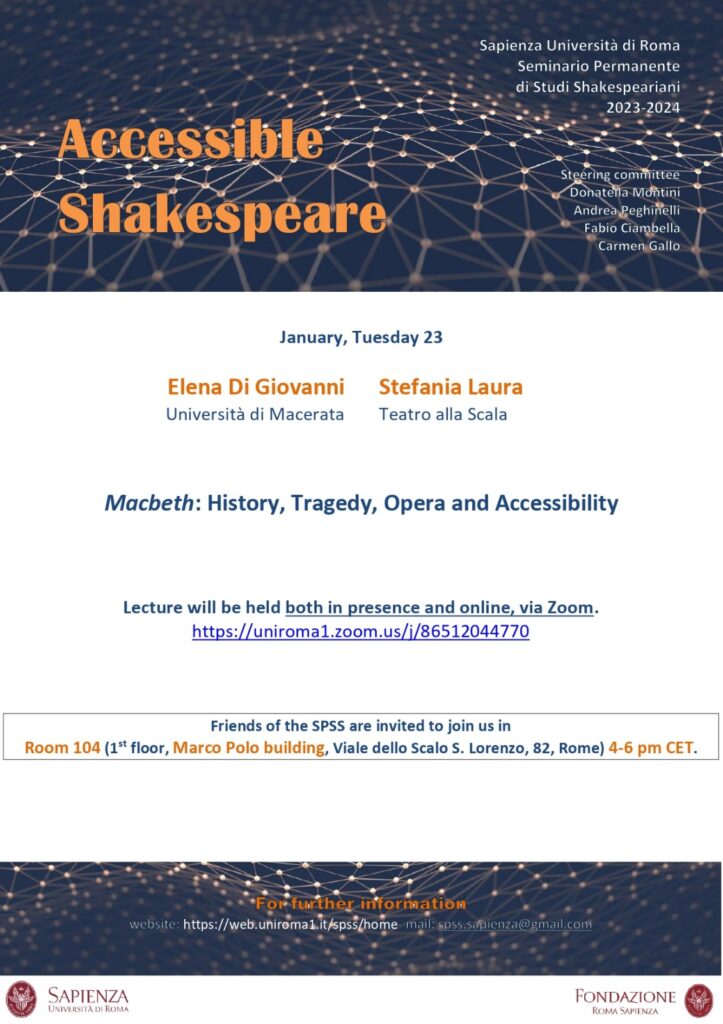
Macbeth: History, Tragedy, Opera and Accessibility – Sapienza Università di Roma. 23 January 2024

Dear all, We are pleased to announce the third event related to this year’s seminars, featuring Prof. Elena Di Giovanni (University of Macerata) and Stefania Laura (Sovrintendenza Teatro La Scala di Milano) with a presentation titled “Macbeth: History, Tragedy, Opera and Accessibility.” You are all invited to participate in person (Room 104, Marco Polo building, please see the attached poster) or online via the following Zoom link: https://uniroma1.zoom.us/j/86512044770 on Tuesday, January 23rd at 4:00 PM CET. Further info in the poster attached. The steering committee. Donatella Montini Andrea Peghinelli Fabio Ciambella Carmen Gallo 

Macbeth: History, Tragedy, Opera and Accessibility – Sapienza Università di Roma. 23 January 2024 Read More »

Torna in alto