CfPs: Journals

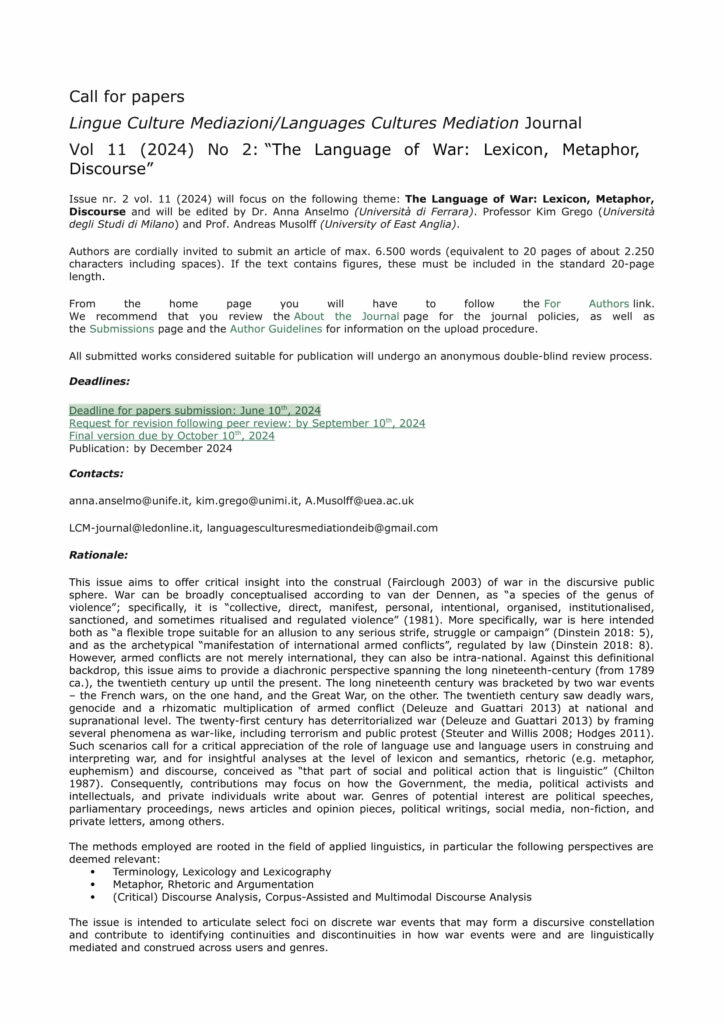
CfP Lingue “Culture Mediazioni/Languages Cultures Mediation Journal”: “The Language of War: Lexicon, Metaphor, Discourse”

Call for papers Lingue Culture Mediazioni/Languages Cultures Mediation Journal Vol 11 (2024) No 2: “The Language of War: Lexicon, Metaphor, Discourse” Issue nr. 2 vol. 11 (2024) will focus on the following theme: The Language of War: Lexicon, Metaphor, Discourse and will be edited by Dr. Anna Anselmo (Università di Ferrara). Professor Kim Grego (Università degli Studi di Milano) and Prof. Andreas Musolff (University of East Anglia). Authors are cordially invited to submit an article of max. 6.500 words (equivalent to 20 pages of about 2.250 characters including spaces). If the text contains figures, these must be included in the standard 20-page length. From the home page you will have to follow the For Authors link.We recommend that you review the About the Journal page for the journal policies, as well as the Submissions page and the Author Guidelines for information on the upload procedure. All submitted works considered suitable for publication will undergo an anonymous double-blind review process. Deadlines: Deadline for papers submission: June 10th, 2024Request for revision following peer review: by September 10th, 2024Final version due by October 10th, 2024Publication: by December 2024 Contacts: anna.anselmo@unife.it, kim.grego@unimi.it, A.Musolff@uea.ac.uk LCM-journal@ledonline.it, languagesculturesmediationdeib@gmail.com Rationale: This issue aims to offer critical insight into the construal (Fairclough 2003) of war in the discursive public sphere. War can be broadly conceptualised according to van der Dennen, as “a species of the genus of violence”; specifically, it is “collective, direct, manifest, personal, intentional, organised, institutionalised, sanctioned, and sometimes ritualised and regulated violence” (1981). More specifically, war is here intended both as “a flexible trope suitable for an allusion to any serious strife, struggle or campaign” (Dinstein 2018: 5), and as the archetypical “manifestation of international armed conflicts”, regulated by law (Dinstein 2018: 8). However, armed conflicts are not merely international, they can also be intra-national. Against this definitional backdrop, this issue aims to provide a diachronic perspective spanning the long nineteenth-century (from 1789 ca.), the twentieth century up until the present. The long nineteenth century was bracketed by two war events – the French wars, on the one hand, and the Great War, on the other. The twentieth century saw deadly wars, genocide and a rhizomatic multiplication of armed conflict (Deleuze and Guattari 2013) at national and supranational level. The twenty-first century has deterritorialized war (Deleuze and Guattari 2013) by framing several phenomena as war-like, including terrorism and public protest (Steuter and Willis 2008; Hodges 2011). Such scenarios call for a critical appreciation of the role of language use and language users in construing and interpreting war, and for insightful analyses at the level of lexicon and semantics, rhetoric (e.g. metaphor, euphemism) and discourse, conceived as “that part of social and political action that is linguistic” (Chilton 1987). Consequently, contributions may focus on how the Government, the media, political activists and intellectuals, and private individuals write about war. Genres of potential interest are political speeches, parliamentary proceedings, news articles and opinion pieces, political writings, social media, non-fiction, and private letters, among others. The methods employed are rooted in the field of applied linguistics, in particular the following perspectives are deemed relevant: The issue is intended to articulate select foci on discrete war events that may form a discursive constellation and contribute to identifying continuities and discontinuities in how war events were and are linguistically mediated and construed across users and genres. Keywords: Corpus-Assisted Discourse Studies, (Critical) Discourse Analysis, Multimodality, Terminology, Historical Lexicography, War, Conflict. Bibliography Blaxill, L. (2020). The War of Words: The Language of British Elections 1880-1914. Boydell & Brewer. Chilton, P. (1987). Metaphor, Euphemism and the Militarization of Language. Current Research on Peace and Violence, 10(1), 7–19. https://www.jstor.org/stable/40725053 Chilton, P. A. (Ed.). (1998). Political Discourse in Transition in Europe 1989 – 1991. Benjamins. Deleuze, G., Guattari, F., & Massumi, B. (2013). A Thousand Plateaus: Capitalism and Schizophrenia. Bloomsbury Academic. Dinstein, Y. (2018). War, Aggression, and Self-Defence, 6th Edition. Cambridge University Press. Fairclough, N. (2003). Analysing Discourse: Textual Analysis for Social Research. Routledge. Hayes, N., & Hill, J. (Eds.). (1999). Millions Like Us?: British Culture in the Second World War (DGO-Digital original). Liverpool University Press. https://www.jstor.org/stable/j.ctt5vjdhc Heer, H. et al. (Eds.). (2008). The Discursive Construction of History: Remembering the Wehrmacht’s War of Annihilation. Palgrave Macmillan. Hodges, A. (2011). The “War On Terror” Narrative: Discourse and Intertextuality in the Construction and Contestation of Sociopolitical Reality. Oxford University Press. Hodges, A. (2015). War Discourse. In K. Tracy, T. Sandel, & C. Ilie (Eds.), The International Encyclopedia of Language and Social Interaction (1st ed., pp. 1–6). Wiley. https://doi.org/10.1002/9781118611463.wbielsi026 Jackson, R. (2005). Writing the War on Terrorism: Language, Politics, and Counter-Terrorism. Manchester University Press. Kelly, M., Footitt, H. & Salama-Carr, M. (Eds.). (2019). The Palgrave Handbook of Languages and Conflict. Palgrave Macmillan. Kennedy, C. (2013). Narratives of The Revolutionary and Napoleonic Wars: Military and Civilian Experience in Britain and Ireland. Palgrave Macmillan. Pratt, M. L. (2009). Harm’s Way: Language and the Contemporary Arts of War. PMLA/Publications of the Modern Language Association of America, 124(5), 1515–1531. https://doi.org/10.1632/pmla.2009.124.5.1515 Russell, G. (1995). The Theatres of War: Performance, Politics, and Society, 1793-1815. Clarendon Press ; New York : Oxford University Press. Steuter, E., & Wills, D. (2008). At War with Metaphor: Media, Propaganda, and Racism in the War On Terror. Lexington Books. Thorne, S. (2006). The Language of War. Routledge. Walker, J., & Declercq, C. (Eds.). (2021). Multilingual Environments in the Great War. Bloomsbury Academic.

CfP Lingue “Culture Mediazioni/Languages Cultures Mediation Journal”: “The Language of War: Lexicon, Metaphor, Discourse” Read More »

Call for papers – Rhesis. International Journal of Linguistics, Philology and Literature

Call for papers Rhesis. International Journal of Linguistics, Philology and Literature The call for papers is ongoing and has no deadline. Articles submitted to the Journal are organized into two sections (Linguistics and Philology, and Literature) and will be published on the website as they are accepted, typeset, and finalized for inclusion in the current year’s volume. The yearly volume will close on December 31st of each year. From January 1st 2023 it will be possible to submit essays and scientific studies to the editorial board of the journal Rhesis for the 14.1 (2023) and 14.2 (2023) issue. This invitation is valid for the whole of 2023. The studies will be published on the website when ready, starting from January 1st, 2023. The annual closing of the journal is supposed to be on December 31st each year. The articles submitted after October 30th, 2023 will be automatically considered for the following year’s issue, published with the same procedure starting from January 1st, 2024 to December 31st, 2024. Rhesis uses a double-blind peer-review process to evaluate scientific manuscripts. When an article is submitted to the Journal, the Editorial board reviews it to ensure that it meets the Journal’s scope and standards, which usually takes about one week. If the manuscript is deemed suitable for peer-review, it is sent to two reviewers who are experts in the same field as the author. To ensure objectivity, both the reviewers and the author are kept anonymous from each other. The reviewers usually have four weeks to complete their review and provide feedback to the editors and the authors. The feedback may include suggestions for revisions or improvements to the manuscript. Once the reviews are complete, the Editorial board carefully evaluates the feedback and makes a decision on whether to accept the manuscript for publication, request revisions from the authors, or reject the manuscript. If a manuscript is found to be unsuitable for publication in the journal, either because it does not meet the journal’s scope and standards or because of other reasons, it may be rejected by the Editors without being sent out for review by external experts (Desk rejection). Rhesis. International Journal of Linguistics, Philology and Literature is an international, academic, double-blind peer-reviewed, on line and open access Journal. Rhesis is ranked “rivista scientifica ANVUR” for academic area 10. It is indexed in MIAR and is present in the ACNP, BASE, ROAD, WorldCat databases. The peer-review process is managed through the OJS platform. For further information, please visit the journal website: https://ojs.unica.it/index.php/rhesis/about https://ojs.unica.it/index.php/rhesis/call

Call for papers – Rhesis. International Journal of Linguistics, Philology and Literature Read More »

CfP: «Cross-Media Languages. Applied Research, Digital Tools and Methodologies», 2 (2024)

Call for papers È aperta la call per il numero 2 (2024) di «Cross-Media Languages. Applied Research, Digital Tools and Methodologies».  Le proposte, in forma di abstract (max. 500 caratteri, spazi inclusi), dovranno pervenire all’indirizzo cml.journal@uniba.it, entro il 15 luglio 2023. Notifica per l’accettazione dei contributi: 30 luglio 2023. La scadenza per la consegna dei contributi è fissata al 5 marzo 2024. I saggi dovranno essere inediti e non superare i 35.000 caratteri (spazi inclusi). La pubblicazione è prevista per maggio 2024. Per altre informazioni si consulti la pagina Proposte.  Deadlines for the second issue (2024) of «Cross-Media Languages. Applied Research, Digital Tools and Methodologies». Abstract submission deadline (500 characters max.): 15th July 2023; send to cml.journal@uniba.it. Notification of acceptance: 30th July 2023 Paper submission: 5th March 2024 Word count: 35.000 characters max (The character limit includes spaces) Publication: May 2024 For more information, see the web page Proposte. Trovate la call for papers al seguente link: https://ojs.cimedoc.uniba.it/index.php/cml/pages/view/callpapers  

CfP: «Cross-Media Languages. Applied Research, Digital Tools and Methodologies», 2 (2024) Read More »

Torna in alto